
Experience 300 Years of Norwich History
The primary goal of this website is to educate the public about Norwich, Connecticut’s rich heritage and history spanning the 300-year period from 1659 to 1959. The site offers quick and easy access to an extensive collection of media, focusing on Norwich’s historical events, places, and other interesting tidbits.
This site is entirely free of charge
IconicNorwich.org features over 3,000 concise articles and numerous historical maps of Norwich. The articles are organized into more than 30 categories. The Bibliography connects you to thousands of historical web-based links from Norwich. Several quizzes, prepared presentations, and crossword puzzles are provided to enhance the learning environment.
You are invited to add or contribute to new or existing placemarks by filling out the form in the “Contribute Article” section.

Recent Updates to IconicNorwich.org
Updated: Sarah Kemble Knight: Click Here
Added: Caleb B. Rogers Biography: Click Here
Added: Winslow Tracy Williams Biography: Click Here
Added: Sarah Osgood Biography: Click Here
Added: John C. Perkins Biography: Click Here
Added: George W. Kies Biography: Click Here
Legend of the Micah Apple
Norwich History … It Never Gets Old
The Micah Apple (a.k.a. the Mike Apple) was the fruit of a cursed apple tree in West Farms (today’s North Franklin, Connecticut). Many historians have documented the tree’s origin and its fruit. At the heart of the legend is the story of an alleged murderer, Micah Rood.
Micah Rood, Thomas Rood’s youngest son, an early settler on the east side of the Shetucket, moved to West Farms in Peck Hollow in 1699. Micah had an apple tree on his farm that bore large, fair fruit, but each apple always had a red globule, like a clot of blood, near the center. The apple, which became a great favorite in Southeastern Connecticut and was called the Mike apple from its originator, still remains the subject of much curious inquiry.
The drop of blood invariably found in every apple has long been a wonder, and the story of its origin, handed down from father to son for over a hundred years, has grown into a fixed tradition, implicitly accepted.
As the story goes, a peddler entered town, selling costly and luxurious wares never before seen in the settlement. The simple Micah, dazzled by the display, invited the peddler to his house, and at an evil moment plunged a knife to his heart beneath this very tree, so that his life blood flowed down and mingled with its roots.
The next spring its blossoms changed from snowy white to red, and in August when the apples came tumbling down, large and yellow and juicy, horror of horrors, there hung in every one a drop of blood …
Click HERE to read the full story of the Micah Apple
Click HERE to read previous “Norwich History … It Never Gets Old” articles
“Norwich History … It Never Gets Old” is normally published here every Friday.
The next issue will appear here on Sunday, November 1
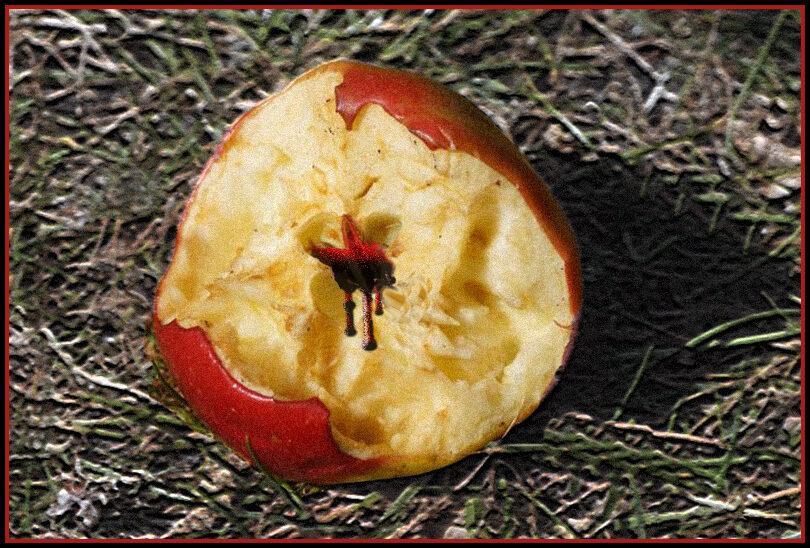
Legend of the Micah Apple
*Place your cursor over image to magnify
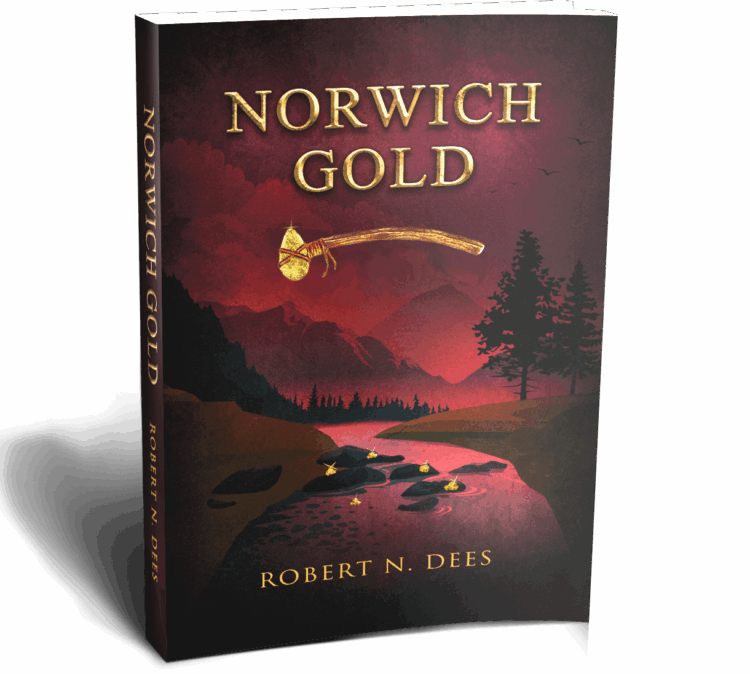
An historical fiction novel by Bob Dees about Norwich's 1850s Gold Mining Company. Click image to see.
The IconicNorwich.org website was designed, developed, and is maintained by Bob Dees