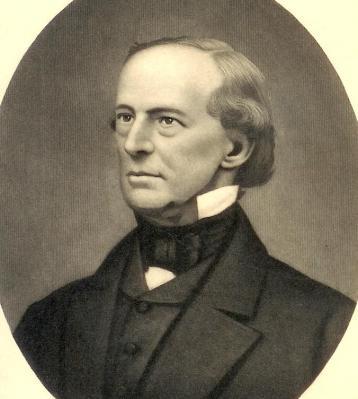
Charles Osgood was born in Lebanon, CT., in February 1808. Following his graduation from Plainfield Academy, he continued to pursue an interest in medicine, which was undoubtedly influenced by his father, Dr. Erastus Osgood, a successful physician who practiced for nearly half a century. Charles graduated with a medical degree from Yale and began practicing in Providence, RI. However, he soon relocated to Monroe, Michigan, where he joined an extensive and thriving medical practice. In 1840, Charles returned to Norwich and, in the following year, established his drug business, which subsequently made his name familiar in the business circles of the East.
He set up his first laboratory and drug store on Shetucket Street in the same building later used by the Henry Bill Publishing Company A later, much larger building was located at 45-47 Commerce Street, which sold drugs, patent medicines, white lead, painters’ supplies, kerosene oil, chimneys and burners, Masury’s railroad colors, and Osgood’s steamboat oil (a water-white illuminating oil with a 150-degree test). His business grew and prospered, and soon Charles Osgood was ranked among Connecticut’s most notable millionaires.
In addition to the pharmaceutical business, Osgood was connected with many prominent manufacturing and corporate institutions, including: the Boston Rubber Shoe Co. in Malden, MA; the Brown Cotton-Gin Co. at New London; the Norwich City Gas Co. He was founder of the Shetucket Bank, and president until 1853, and Vice President of the Norwich Savings Society. He was director of the New London Fire Insurance Co. and in the Norwich Water Power Co. He was president of the New London Junction Railroad.
With a mind toward civil responsibility, Charles Osgood was a founder and incorporator of Norwich Free Academy. He served as mayor of Norwich, but had to resign halfway through his term due to failing health.
He died in March 1881, leaving a wife and two sons: Charles H. and F. L. Osgood, and a daughter (wife of A.C.Tyler of New London).
References
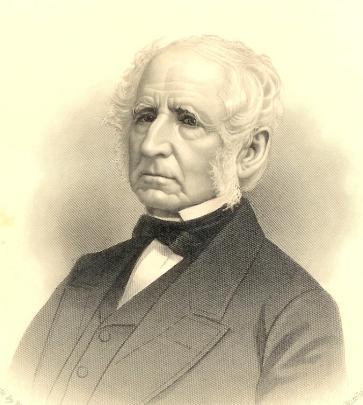
Charles Johnson was born in Jewett City, April 1806, the fourth son of nine children of Obadiah and Lucy (Cady) Johnson. When about fourteen years of age, Charles began working in the local cotton mill. After two years, he was taken into the factory-store and office, where he remained until the mill was sold to Samuel and John Slater in 1823. In 1824, Charles was employed as an accountant by the Hopkins & Morse Machine Company of Norwich, then in 1827 as a bookkeeper in the Griswold Woolen Co., by Trumbull, Breed & Co.
At twenty-one, Charles invested his savings in partnership with his father in a prosperous mercantile enterprise under the firm name of John Johnson & Son. This early success was a clear indication of his shrewd business acumen. Later, he managed a store at Norwich Falls under the firm name of Cobb & Johnson.
When the Jewett City Bank was established in 1831, Mr. Johnson was appointed as its cashier at a modest annual salary of $200.
Three years later (1835), Mr. Johnson accepted a cashier’s position at the Norwich Savings Bank at a yearly salary of one thousand dollars. He was appointed a trustee in 1840 and then became a director. In 1847, upon the death of the late Jabez Huntington, Charles Johnson was chosen president of the Norwich Savings Society, a position he held until his death in April 1879. The Norwich Savings Society was the second-oldest and largest savings bank in the state. Under Charles Johnson’s leadership, the deposits swelled from less than $150,000 to nearly $8,000,000. The bank’s clientele grew to about 50,000 customers.
In addition to his regular banking business, Mr. Johnson was called upon to administer several public and private trusts. He was a trustee for the Otis Library from the first meeting of the trustees and for the fund supporting the families of Civil War veterans.
Mr. Johnson was a director of the Norwich & Worcester Railroad from 1848 to 1869. From 1845 to 1851, he was president of the Norwich Fire Insurance Company. For six years before his death, he was involved in reorganizing the Southern Minnesota Railroad. He was the originator of the Norwich City Gas Company and served as a director until his death. In 1864, his income was reported to be $8,417 ($194K today).
Mr. Johnson was an active member of the Second Congregational Church until the formation of Park Congregational Church. Charles Johnson was one of the incorporators of the Norwich Free Academy. Although he lived a very unostentatious life and died without any significant accumulation of wealth, it has been estimated that Charles Johnson distributed nearly $150,000 during his life for religious and benevolent purposes, as well as personal charities. Never one to be swayed by a politician and not always hopeful in his views, he nevertheless took a decided interest in national affairs and was fond of discussing them with his friends. During the anti-slavery movement, he was a strong abolitionist and a proponent of universal human brotherhood.
During his lifetime, Mr. Johnson’s life was robbed three times by the untimely deaths of his conjugal partners and the loss of two children. The only surviving child was Mr. Charles C. Johnson, Jr. of this city.
References
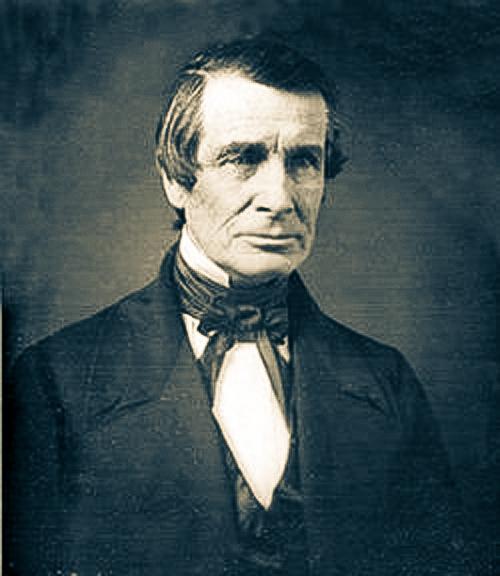
Colonel Charles Coit was born in February 1793 and, at a young age, took part in the War of 1812. Afterward, Charles was active in the militia, rising to the rank of colonel in the artillery. He came to Norwich in 1817 and engaged in the mercantile business, which he pursued in various forms, particularly the grocery business, which he actively pursued until his death in October 1855 at the age of sixty-two.
Charles was a member of the Second Congregational Church, serving as Deacon and superintendent of the Sabbath School.
Charles married Lucretia Tyler in May 1821, who died in 1822. He soon married again, Lydia Tyler, the sister of his first wife, who died in October 1834. From this second marriage, two children were born, Lucretia and one unnamed, both of whom died in infancy.
A third marriage took place when Charles married Sarah Perkins Grosvenor, the daughter of General Lemuel Asa Grosvenor. They had four children: Ellen Grosvenor (1835), Charles Morgan (1838 – 1878), Sarah Perkins (1840 – 1843), and George Douglas (1845-1906). Following her husband’s death, Ellen Grosvenor Coit left Norwich to spend her winters in New York and her summers at Eastern Point in Groton.
References
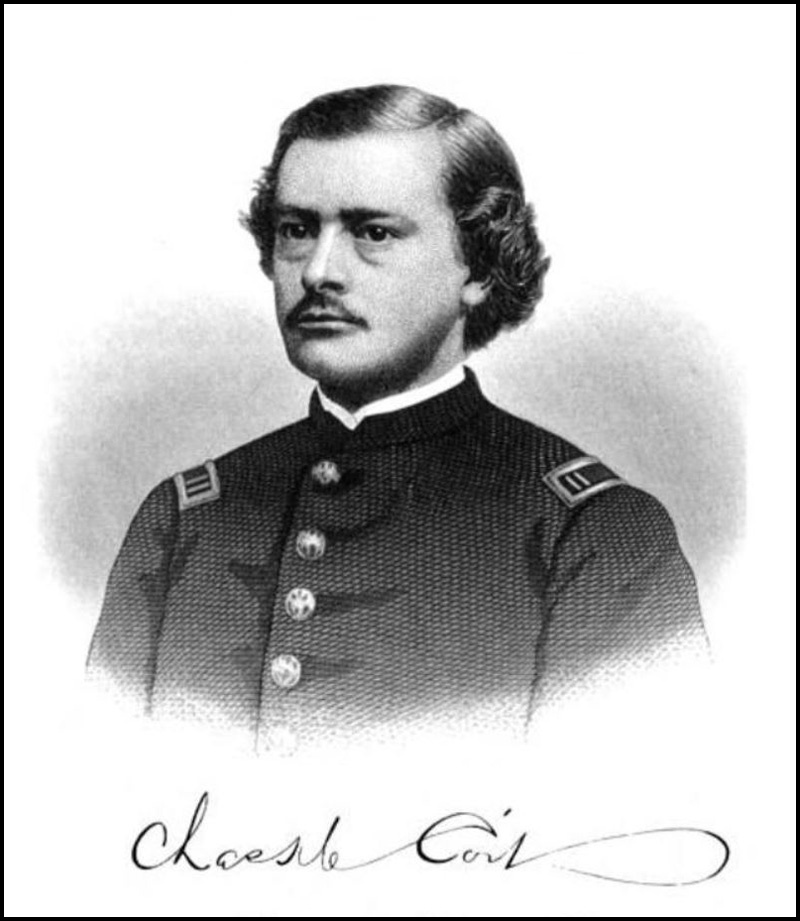
Charles Morgan Coit, son of Charles Coit, was born in Norwich in March 1838. At the age of seventeen, the death of his father caused him to drop out of college and enter the business world reluctantly. He was initially employed at the Uncas Bank in Norwich. Still, at the young age of twenty-one, he was soon selected to be treasurer of the Chelsea Savings Bank, following the departure of the previous treasurer after just one year of service. Charles was held in the highest esteem by bank officials, so that when the Civil War broke out, if he volunteered to fight, his bank position would remain open for him. Unable to leave home due to family and business obligations when the first call for enlistment was made, Charles could not resist Lincoln’s second call for volunteers and, in 1861, joined the service as adjutant of the 8th Connecticut Volunteer Infantry, organized under General Edward Harland.
Charles was wounded at Fair Oaks, Virginia, in 1864, and upon his recovery, he was promoted to brevet in March 1865 and discharged in May 1865. Upon returning to Norwich, Colonel Coit was offered his former position as treasurer of the Chelsea Savings Bank, which he accepted.
Charles was an aide to Second Congregational Church as Deacon and treasurer.
Colonel Coit lost his life in July 1872 by drowning in New London. His infant son had fallen overboard from a yacht, and in his effort to rescue his little boy, which he was successful in doing, he lost his own life.
Charles was married to Mary B. Hillard in June 1872. They had two sons: Charles (1873) and Augustus (1876).
Following the untimely death of Colonel Charles Coit in 1872, his brother George D. Coit, then treasurer of the Dime Bank, was chosen to fill his position of treasurer at the Chelsea Savings Bank. In July 1878, George transferred his services to the Chelsea Savings Bank, where he remained until his death in October 1906.
Reference