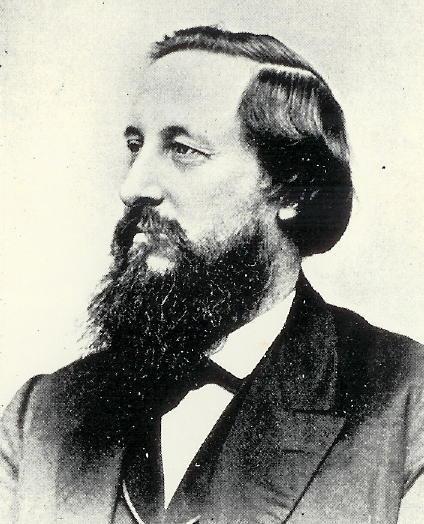
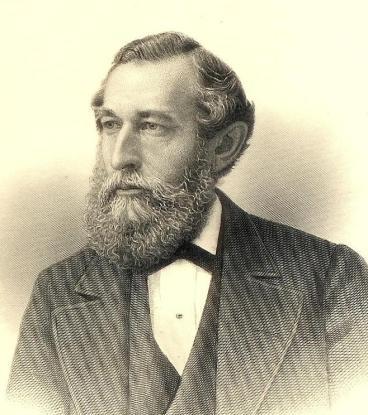
Few of the sons of Norwich have made a more lasting impression upon its material and moral interests than Henry Bill. Born in May 1824, Henry was the second-born of Burdon and Lucy Bill in the northern part of Groton, now the town of Ledyard. He attended the academy in Plainfield, then one of the most celebrated schools in the country. Following graduation, he taught in Plainfield and Groton until age 20. Henry accepted an offer from a relative, Hon. James A. Bill of Lyme, who owned a book publishing company in Philadelphia, to work for him.
He learned the publishing business and traveled frequently throughout the western states, selling books door-to-door, a typical sales method at the time. After three years, he returned to Norwich in 1847 to open his own book publishing company. He was encouraged by the elder Harper Bros. of New York, who recognized Henry’s skills and provided him with unlimited credit.
Henry’s company, located at Water and Shetucket Street, produced hundreds of thousands of books, primarily focusing on travel or religious themes, such as Alvan Bond’s “History of the Bible.” Henry Bill’s publishing company grew and prospered over the next twenty-five years. In 1865, the Norwich Board of Trade listed Henry as one of the sixty wealthiest people in Norwich with an annual income of $6,923. With ample prosperity and failing health, Henry embraced retirement. He converted his large publishing business into a joint-stock corporation, which continued to flourish as the Henry Bill Publishing Company.
Henry was a Congregationalist and a member of the Broadway Congregational Church here in Norwich. He was an active member of the Democratic Party and represented the town of Norwich in the State Senate in 1853, receiving a large portion of the votes of his opponents in the election. In 1856, when the party split, he aligned himself with the anti-slavery faction and remained an active member of the Republican Party
Henry was married to Julia O. Chapman of Groton on February 10, 1847. They had seven children. A daughter, Julia F. Bill, married Joseph H. Selden, minister and chairman of the Norwich Chapter of the Red Cross.
References
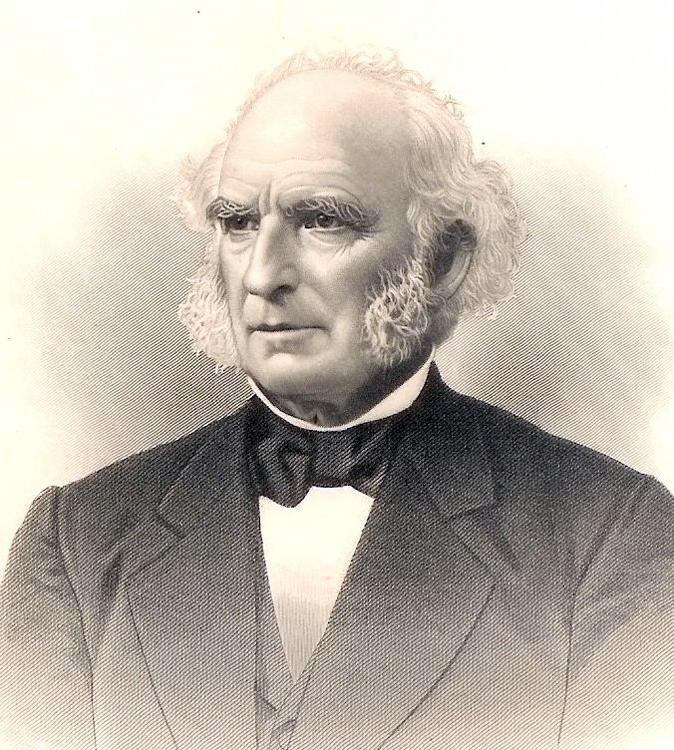
Henry Barker Norton, born in Branford, Connecticut, in 1807, came to Norwich in 1824 with a single dollar in his pocket and pursued a remarkable career in the mercantile, commercial, and manufacturing business. He is credited with helping transform Norwich into a thriving commercial center in the late 1800s.
Three years after arriving in Norwich, Henry was engaged in the wholesale grocery business as a member of the firm Backus & Norton. His partner was Joseph Backus. The business was later known as Norton, Converse & Co., and later as Norton Bros. He remained the senior member until 1877, a 50-year period. During his tenure, the business grew into one of Connecticut’s largest wholesale grocery houses.
He became the President of the Norwich & New London Steamboat Company in 1848, when he and his two brothers, Timothy and William, bought three steamboats. His company managed a vital transit link along the Thames River between Norwich, New London, and New York. The company was dissolved in 1860 and reformed as the Norwich and New York Transportation Company. Mr. Norton also became the first President of the new company.
Mr. Norton also served as President, was one of four major stockholders in the Attawaugan Co., and was a director of the Norwich Bleaching, Dyeing and Printing Co. and the Richmond Stove Co.
Norton held many other business interests, both local and national, including western railroads. He is listed as one of the sixty wealthiest men in Norwich in 1865, with an annual income of $26,969 ($550,000 in 2026 $).
Mr. Norton was interested in community affairs, particularly education. In 1856, he became one of the original incorporators of the Norwich Free Academy and served on the board of trustees for many years. In 1891, Henry donated $200,000 ($7.3 million in 2026 $) to develop a library at the academy. His gift, combined with previous gifts, helped improve the current Bela Peck Library (a gift from Harriet Peck Williams and previously the home of Lafayette Foster), which was renamed the Norton Peck Library and became the largest high school library in the state.
Henry made contributions to many civic organizations, including the development of Norwich’s Y.M.C.A. He was an active member and deacon of the Broadway Congregational Church.
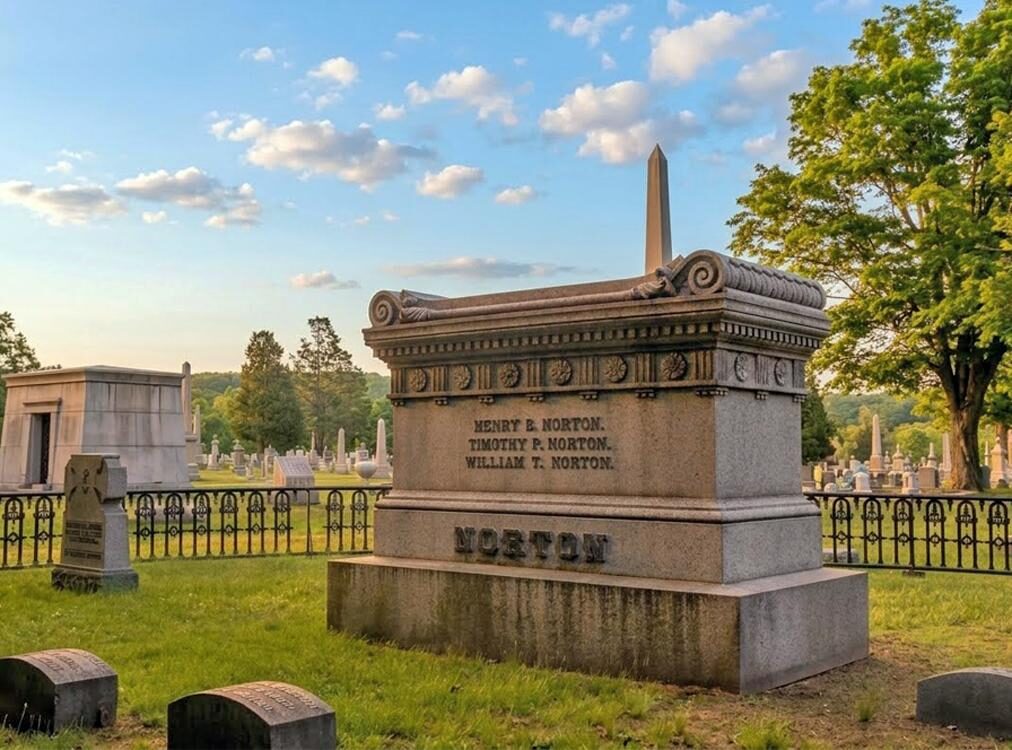
Henry’s unusual middle name, Barker, comes from his mother’s maiden name, Sophia Amelia Barker Norton. He married Emeline Frisbie on June 19, 1887, and they had seven children, but, unfortunately, three died in childbirth. They lived in a beautiful home at 188 Washington Street in Norwich. His daughters Emeline, Mary, and Ella never married.
Timothy and William, his much younger brothers, are buried near him in Yantic Cemetery. His sister, Emily, also enjoyed a comfortable, Victorian-age lifestyle with her husband, Lorenzo Blackstone, who once served as Norwich’s Mayor.
Henry died in October of 1891 at age 84.
*Place your cursor over the photo to magnify
Reference
William Norton was a prominent businessman in Norwich, engaged in the family wholesale grocery business, manager of the Montville Woolen Mills, and one of four major shareholders in the Attawaugan Cotton Mill. The Norwich Board of Trade listed William as one of the sixty wealthiest men in Norwich with an annual income in 1865 of $20,800 ($400,000 in 1016 $).

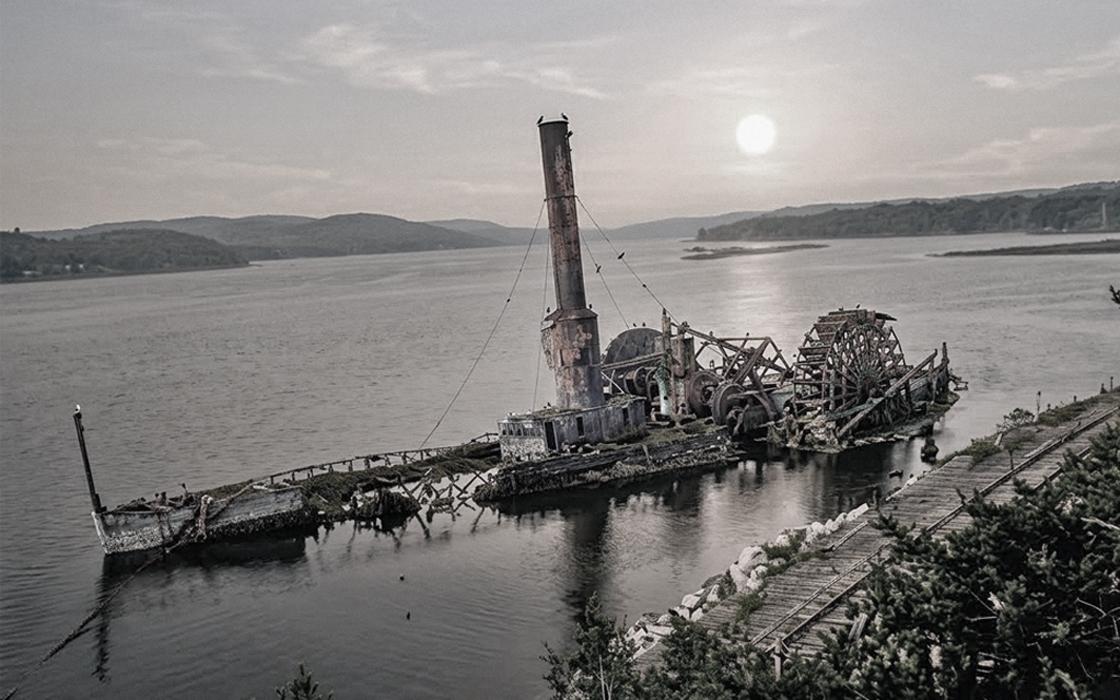
William T. Norton died as a result of a shipwreck. In November 1871, the ship City of New London caught fire in the Thames River when a cook carelessly placed a hot poker next to a wall. The initial fire was thought to have been put out but rekindled in bales of cotton stored on board. In search of additional help to fight the fire, the ship continued upstream toward Norwich until the pilot was forced from the helm by smoke and fire. The ship went aground, and passengers jumped into the freezing water to escape the flames.
Mr. Norton, one of the passengers on board that night, was able to rescue several swimmers and reportedly gave a life vest to the sole female passenger, but due to exhaustion and icy temperatures, he drowned in his final efforts. A $1,000 reward was offered to anyone who could recover his body, which was found nine weeks later by a young girl. The reward money was used toward her education.
Caleb B. Rogers, another well-known Norwich manufacturer, also perished in the accident.
Norton was 44 years old.
Reference
Lorenzo Blackstone was born in Branford, CT, in June 1819 and was a direct descendant of William Blackstone, the first settler of Boston. He was educated in local schools. His business skills were demonstrated early in his career when he traveled to Liverpool, England, in 1842 and established a commission house for the sale of American products. He became the first to introduce goods such as boots and overshoes from the Goodyear Rubber Company into Great Britain.
His business continued to grow, and soon he was distributing merchandise throughout Europe and as far away as Australia. In 1846, he became the exclusive distributor for products from the Hayward Rubber Co. of Colchester, CT., and soon after invested in their stock. The sale of rubber boots and overshoes generated several hundred thousand dollars annually.
In 1855, Lorenzo returned to Branford, where he continued to operate his business through a branch office. Influenced by his brothers-in-law (the Nortons), Governor Buckingham, and other officers of the Hayward Rubber Co., Mr. Blackstone moved to Norwich. He made that thriving city his permanent home. In 1859, he sold off his business in Europe and began investing heavily in the manufacture of cotton goods.
Mr. Blackstone purchased the burned-out Blashfield factory in Dayville, CT, and replaced it with a larger brick cotton mill capable of 10,000 spindles. The business was named Attawaugan Mills. Business demand enabled expansion and the addition of equipment, which increased total capacity to 28,000 spindles. In 1865, he enlarged the business with the purchase of adjacent water privileges owned by Leonard Ballou and erected another mill with an eighteen-thousand-spindle capacity. He purchased the Amsbury privilege and erected another weaving mill at that site.
The Attawaugan Manufacturing Co. was solely owned and operated by Mr. Blackstone, together with his brothers-in-law, Henry B. Norton, Timothy P. Norton, and William T. Norton. The company had a combined annual output of 9,000,000 yards. In 1870, the company purchased the Totokett Mills in Occum, which produced woolen goods, and converted them to a cotton manufacturing facility with a capacity of 14,000 spindles, 300 looms, and an annual production of 2,000,000 yards of cloth. In 1877, it built the Pequot Mills in Montville. The 1865 Norwich Board of Trade listed Blackstone’s yearly income at $41,000. The tremendous success of Lorenzo Blackstone’s mills provided many jobs and prosperity to the surrounding community.
As a successful capitalist, Lorenzo was interested in various other corporations. He was the director of the Ponemah Mills Manufacturing Company. He was the president of the Chelsea Savings Bank and the Thames National Bank, and served as a director of the Chicago and Alton Railroad of Illinois. Mr. Blackstone also had an active public spirit and interest in the welfare of Norwich and its citizens. He was a trustee of the Norwich Free Academy and served as alderman of the city for several years, as well as a member of the Court of Common Council for several years. From 1866 to 1870, he served as mayor of the town, and from 1878 to 79 served in the state senate.
In October 1842, he married Emily, daughter of Asa Norton, of Branford. Their family consisted of James De Trafford, Harriet Belle, Ellen Frances, William Norton, and Louis Lorenzo, all of whom lived in Norwich.
Following his death, the operation of his manufacturing enterprises was carried on by his two sons.
References