Howard L. Stanton (1854-1935)

*Place cursor over images to magnify

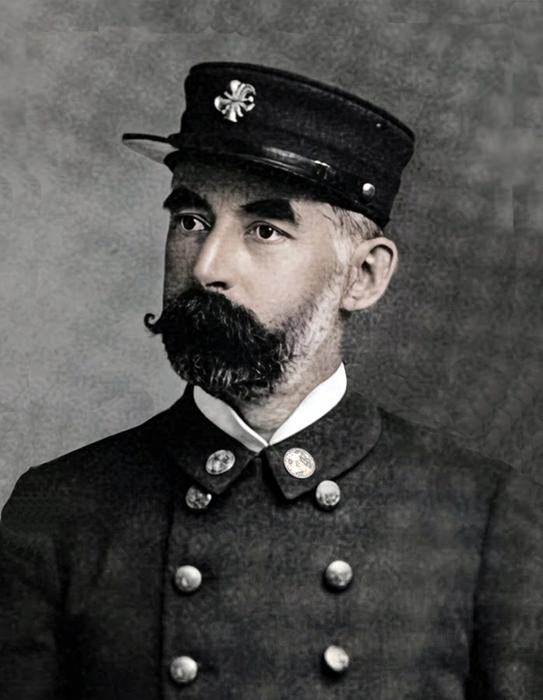
Howard L. Stanton was born in Norwich on July 17, 1854. He was a member of the Norwich Fire Department for more than 58 years (1871-1929) and was the Chief of the department for 28 years (1901-1929).

He began his affiliation with the Norwich Fire Department as a runner with the Neptune Steam Fire Engine Company Number 2 in 1871. Over the years, as respect from his fellow firefighters grew, he rose through the ranks from 2nd Assistant Foreman to Engine Stoker to Captain to Second Assistant to, finally, Chief Engineer of the Department.

The history of his connection with the fire department is practically a history of the department. He accompanied the department to the Great Boston Fire of November 1872, which he declared was the most instructive trip in that line he had ever taken.

Chief Stanton was very involved in the community. In 1913, he wrote an article titled “How to Interest School Children.” The article stressed the importance of teaching fire safety.

Under his masterful administration and enthusiasm for improving the Norwich Fire Department, Chief Stanton introduced many changes. Beginning with the creation of a volunteer department, he also introduced horses to the force, hired 6 permanent firemen, added 14 additional fire alarm boxes, added a complete fire alarm telegraph, and, mainly through his efforts, convinced Norwich to build a new central fire station, which opened on December 3, 1904.

In July 1875, Mr. Stanton became a toolmaker at the newly organized Norwich Pistol Company factory. However, after a short time, he accepted a more lucrative position with the Bacon Arms Company. He worked at the gun factory for more than five years.

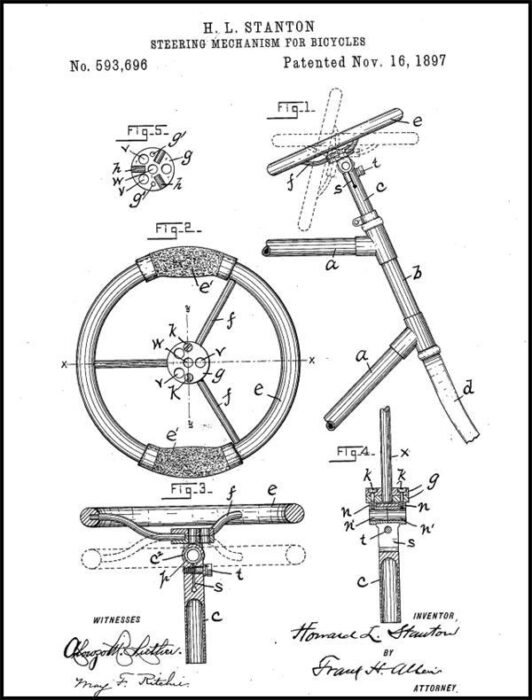
In 1897, Mr. Stanton exhibited his concern for public safety when he invented a bicycle steering wheel which was safer than standard bicycle handlebars.

Mr. Stanton also served three years on the Town Board of Education, six years as a member of the Board of Education of the West Chelsea School District, two years of which time he was also clerk of the district. He was also a trustee of the Chelsea Savings Bank.

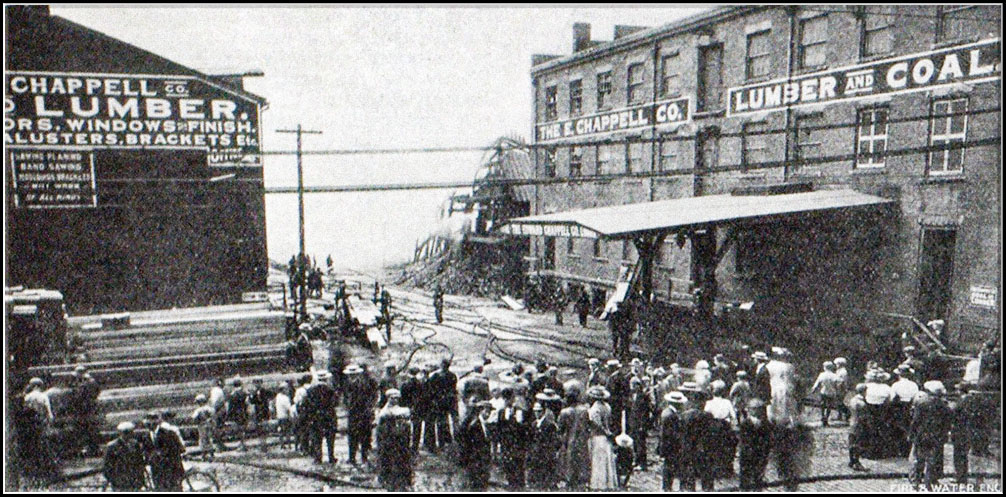
Fire on Norwich's Central Wharf - 1912

Throughout the many years of Stanton’s service countless fire alarms were answered and dealt with by himself and his department. One of the worst fires that they combated was on August 29, 1912, when Norwich’s Central Wharf burned. Chief Stanton estimated the damage at $171,000 ($5.5 million in 2025 dollars).

The flames started on the Central Wharf and burned over an area of 800 feet long by 350 feet wide. The burned buildings had been used as storehouses for lumber and coal and the partition walls were constructed of both brick and wood. The fire was discovered at 11:50 pm by a locomotive engineer, and it is believed to have been started by vagrants who were accustomed to sleeping in the sheds. The body of one man was found in the ruins.

Howard L. Stanton married Fannie L. Hotchkiss  on October 22, 1874. They had two daughters, Amy Louisa in 1878 and Georgie Coit in 1879. The  Stanton family lived in a charming home on Fairmount Street. Six years after his wife Fannie died in 1899, Howard married Katherine K. Kind in 1905. 

Howard L. Stanton died in 1935. He and his first wife, Fannie, are buried in the Yantic Cemetery. 

Acknowledgements

“Genealogical and Biographical Record of New London County, Connecticut,” (1905), pp 632-633, by J.H. Beers

The Norwich Fire Department,” (1906), by Fire and Water Engineering, Vol. 39, pp 92-93

The complete list of sources may be found by clicking the “Bibliography” button, and, then typing “Howard L. Stanton” in the SEARCH box.

William A. Slater (1857-1919)

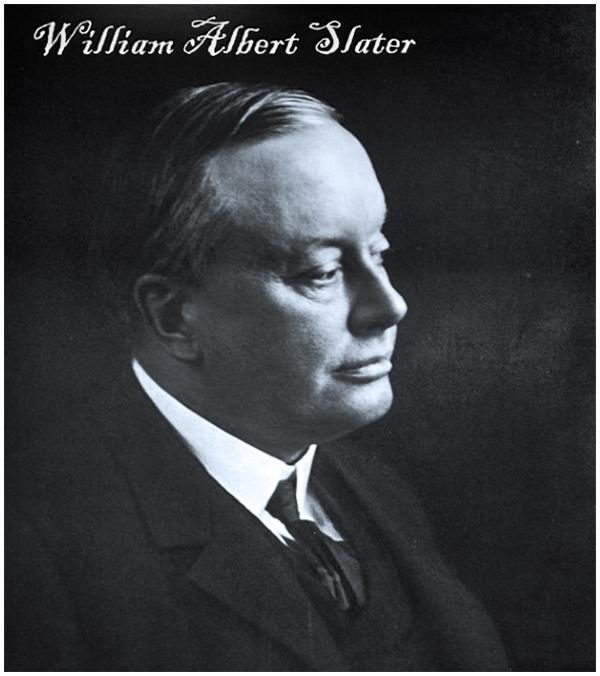
William A. Slater

William A. Slater was born in 1857 in Norwich. His wealth had been established generations earlier in the textile industry in both Rhode Island and Connecticut.  William A. Slater skillfully increased his family’s fortune. He was educated in one of the first classes at the Norwich Free Academy and at Harvard, graduating in 1881. He was the son of the industrialist and philanthropist  John Fox Slater.

In addition to being well educated and successful, William A. Slater appreciated travel, theater, music and art. He and his wife, Ellen, purchased contemporary art during their frequent visits to France. He sponsored the construction of Norwich’s “Broadway Theater” and numerous performances in it. At the same time, his philanthropy provided for the expansion of educational opportunities and affordable access to the arts for Norwich’s citizens. His generosity touched every resident of the city in someway.

His family made its money in the growing textile business, and he was the president of Ponemah Mill in Taftville, one of the world’s largest textile mills.

In 1884 William A. Slater offered to memorialize his deceased father, John Fox Slater, with a new building at the Norwich Free Academy. He chose noted Worcester, Massachusetts architect, Stephen C. Earle, to create a distinctive design. The Slater Memorial Hall was, and remains, one of Earle’s finest works.

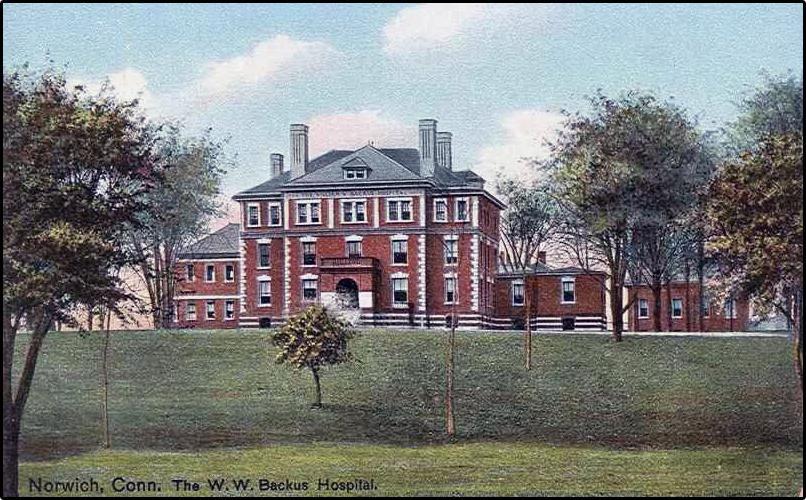
Later, in 1891, he and William W. Backus, spearheaded an effort to build a hospital in Norwich that would serve Southeast Connecticut. Slater, at age 34, donated the 18 acres that today still forms the main hospital campus.

Slater Memorial Hall (pre-1908)
William W. Backus Hospital, circa 1900
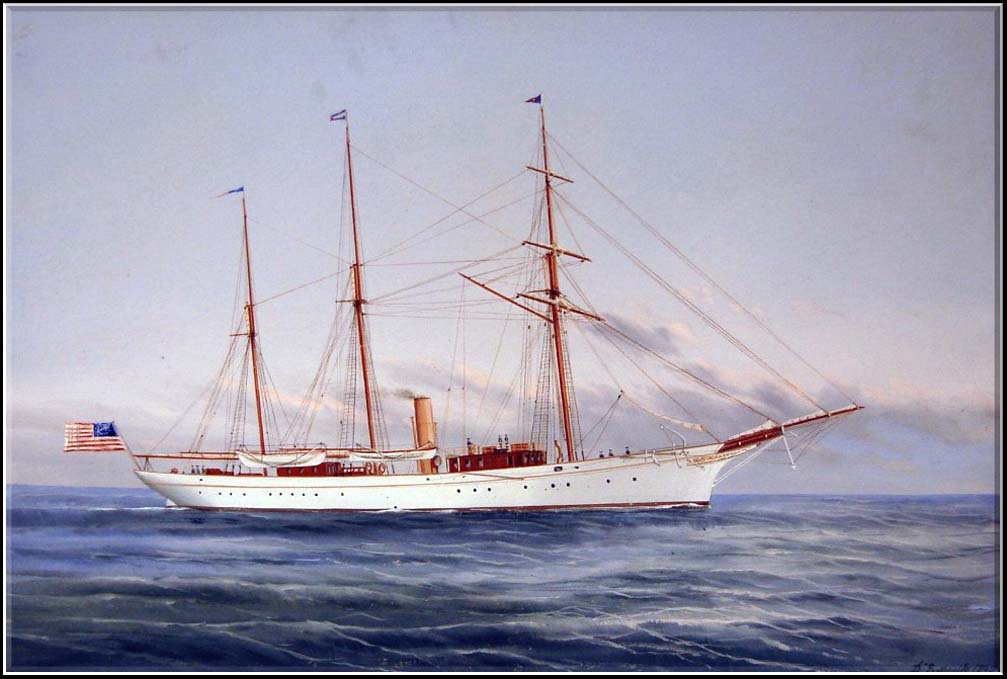
Eleanor : The Maltese Port (1894)

Eight years after he spent $100,000 to build Norwich Free Academy’s Slater Memorial Building to house a museum in honor of his father, William paid $300,000 (more than $8.2 million in 2020 dollars) for a yacht he named after his daughter, the ‘Eleanor‘.

Slater and his wife Ellen, then in their late 30s, planned a 17-month round-the-world tour, traveling with their children Eleanor, age 9, and William, age 5, other family, friends, and various attendants, numbering nearly a dozen in all. They planned to stop in the Azores, France, Italy, proceed through the Suez Canal to Egypt, Bombay, Hong Kong, and Japan. Their trip is chronicled beautifully in Info Source 1.

In 1900 Slater sold the village of Slatersville, Rhode Island and the mill within it to James Hooper. Slater died in 1919 and was survived by his wife Ellen, and two children William A. Slater, Jr. of Norwich and Eleanor Halsey Malone of New York. After his death, Slater’s family sold the remaining Jewett City Mills.

He is buried in Yantic Cemetery.

Acknowledgements

“The Slaters Go Round the World,” by Vivian F. Zoë

“Eleanor : The Maltese Port,” by Vincenzo D’Esposito

The complete list of sources may be found by clicking the “Bibliography” button, and, then typing “William A. Slater” in the SEARCH box.

William Tyler Olcott (1873-1936)

William Tyler Olcott

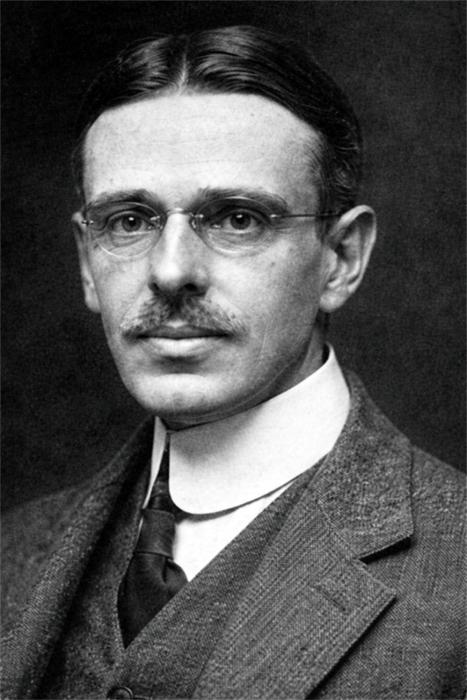
W. Tyler Olcott (January 11, 1873 – July 6, 1936), was an astronomer, author, and lawyer. Tyler was born in the Midwest but chose to live most of his life in the former Christ Episcopal Church rector’s glebe house, at 62 Church Street in Norwich. He graduated from Trinity College in Hartford, then, after attending New York Law School, was admitted to the bar in New York and Connecticut. However, his legal career was limited due to poor health.  Mr. Olcott developed a keen fascination for observing the planets and stars and rose to international recognition as a world-class astronomer.

Olcott was a man always in frail health; however, his strength was found in books and learning. Devotion, partnership, and strength are revealed in his stories of visits to various observatories around the world. While on vacation on Block Island in 1909, he attended Professor Edward Pickering’s lecture focused on the night sky and constellations. From that enlightenment, he developed an insatiable interest in observing
variable stars. According to the dictionary, a variable star is “a star whose brightness varies due to internal changes or periodic eclipsing by mutually revolving stars.”

In 1911, along with six others, he co-founded the American Association of Variable Star Observers (AAVSO), which is still active today. To this day, the AAVSO annually awards the “William Tyler Olcott Award” to an outstanding amateur astronomer.

Ultimately, Mr. Olcott wrote six books, including “The Book of the Stars for Young People” and “Field Book of the Skies,” which were widely read and promoted amateur astronomy.  The purpose of his book for young people was to “blaze a trail for you among the stars in order that you might know your way about the night sky and easily come to know the many objects of beauty and interest that darkness reveals to us … “

Tyler also authored many articles, mentored over 100 observers, and gave countless lectures to popularize amateur astronomy.

Mr. Olcott was a Senior Warden of the Christ Episcopal Church in Norwich. He had strong family ties to the church. Tyler was the great-great-grandson of Reverend John Doolittle Tyler (1742-1823), who served as rector of the church during the turbulent American Revolutionary War period. The Episcopal Church in the Colonies was an offshoot of the Church of England and was NOT popular with many local Norwich Congregationalists. The atmosphere was so toxic that a rumor was spread that the well at Reverend Tyler’s home had been poisoned. Rev. John Doolittle Tyler’s home, the glebe house, was located at 62 Church Street.

William Tyler Olcott’s family moved into this house, his ancestral home, when he was a boy, and he resided there for the remainder of his life.

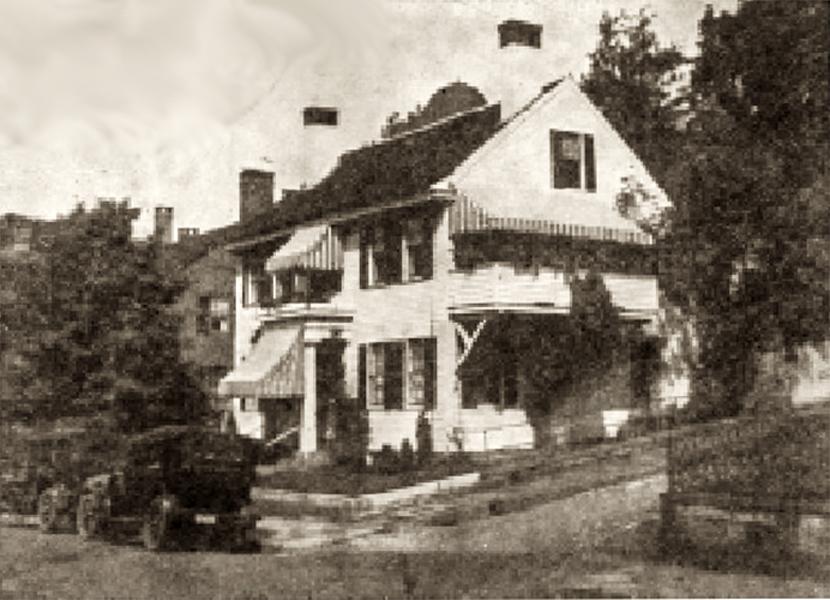
62 Church Street, circa 1921

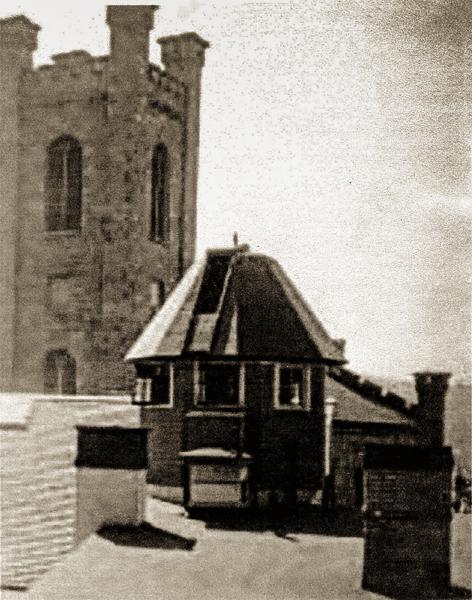
Star Light House, circa 1921

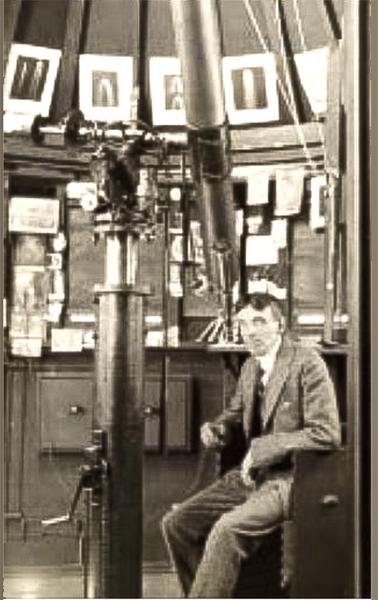
Inside Observatory, circa 1921

In about 1920, William had an observatory built in the attic of his home at 62 Church Street. It was octagonal, had a ten-foot diameter, and occupied the rear roof area of the house. Rollers allowed it to rotate so that the telescope could follow the paths of the stars. The telescope could be cranked from a height of 54″ to 94″. Olcott called it his Star Light House.

The leftmost photo of the Olcott House was taken facing the northwest. The middle photo was taken facing southeast, and shows the Star Light House, with the bell tower of the former Second Congregational Church across the street visible in the background. And, the photo on the right shows Tyler Olcott inside his Star Light House observatory.  *Place your cursor over any image to magnify

NOTE: The Second Congregational Church, shown in the photo, should not be confused with the Christ Episcopal Church on Washington Street.

Tyler Olcott’s will provided for his wife to reside in his family’s ancestral home until her death (which occurred in 1951). Following her death, the ownership reverted to the Episcopal Church. It was Mr. Olcott’s intent that the property be used as either a rectory or a parish. However, the church had recently built a rectory, and the need for a parish house was not deemed expedient since all church activities were centered at its edifice on Washington Street. After Olcott’s wife’s death, the church was authorized to sell the place and convey it to the Otis Library.

In February 1954, the Christ Church glebe house and ancestral home of the Tyler family was conveyed to the Otis Library. The building was used as a branch of the Otis Library for children’s books and other literature from approximately 1954 to 1962.  The trustees of the Otis Library considered building a planetarium and reactivating the Star Light House in 1958. However, at that time, there was also a need to create a book delivery service for Norwich’s elderly and handicapped who could not make it to the library. It was decided to institute the delivery service and to renovate the upstairs of the Olcott House. During the renovation, the Star Light House was dismembered and removed.

Olcott Craters On the Far Side of the Moon

Olcott Craters

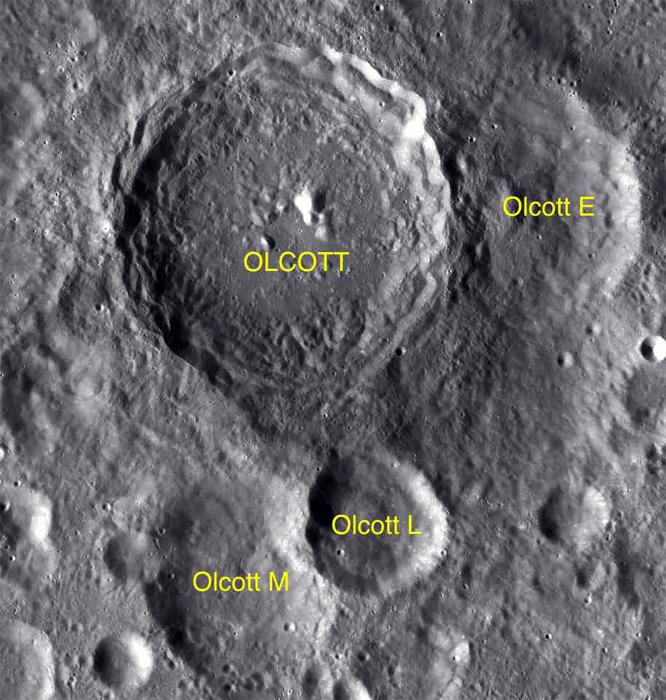
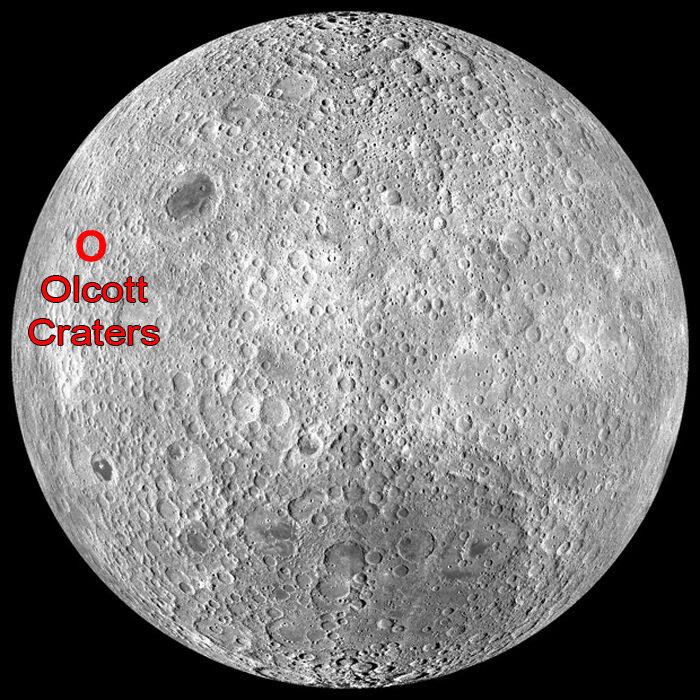
In 1970, the International Astronomical Union honored William Tyler Olcott of Norwich, CT  by naming an impact crater on the far side of the moon after him. Its features are well-defined, and the crater shows no significant evidence of erosion from subsequent impacts.

There are also two satellite craters, Olcott M and Olcott L, that form an overlapping pair along the southern outer rampart of Olcott.  Another satellite crater, Olcott E is partly overlain by the eastern rim of Olcott.

The far side of the Moon photo was taken by NASA’s Lunar Reconnaissance Orbiter in 2011.

*Place your cursor over any image to magnify

Far Side of the Moon

Tyler and Clara Olcott Gravesite

In 1934, Mr. Olcott wrote the lyrics to the song “Ode To Norwich,” which was performed and sung at the opening ceremony of Norwich’s 275th Anniversary. You can see the sheet music for the tune HERE.

In 1902, Tyler married Clara Eunice Hyde (1867-1951) of Yantic. She was a descendant of one of Norwich’s original proprietors, Samuel Hyde. It was written that, “their life together was one of constant devotion and undivided interest.”

William Tyler Olcott passed away after he suffered a heart attack on July 6, 1936, shortly after he gave a talk about the stars to summer residents of a local Methodist Church in New Hampshire.  His funeral was held several days later at Christ Episcopal Church in Norwich. 

It was written, “William Tyler Olcott was a gentleman of the old school – a man of gentle birth and breeding. Not strong of body, but strong of soul and purpose. A man to be respected and admired. A staunch and loyal friend. His life will long continue to be an example of steadfast adherence to principle.”

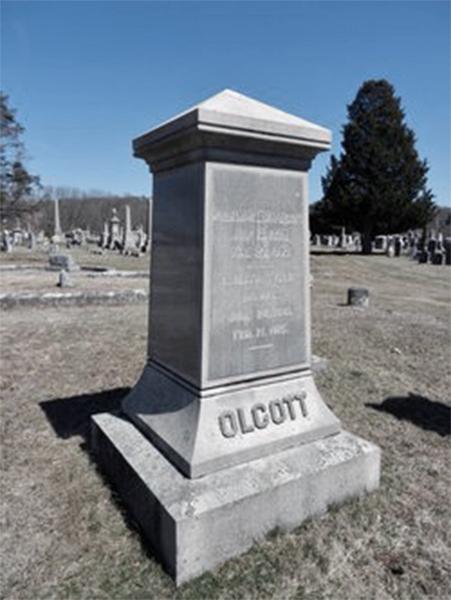
Tyler and Clara are buried in Section 96 in Norwich’s Yantic Cemetery. Their granite monument is shown in the photo. 

Acknowledgements

“William Tyler Olcott,” by David B. Pickering, Popular Astronomy magazine, Vol. XLIV, No. 8, October, 1936, pp 408-411

“The William Tyler Olcott House – Then and Now,” by Dave Hurdis, from the archives of “The American Association of Variable Star Observers”

“William Tyler Olcott, 1873-1936,” FindAGrave.com

“Olcott Crater,” Wikipedia

“Photo Shows Far Side of Moon Like Never Before,” by Space.com

Danny Murphy (1876-1955)

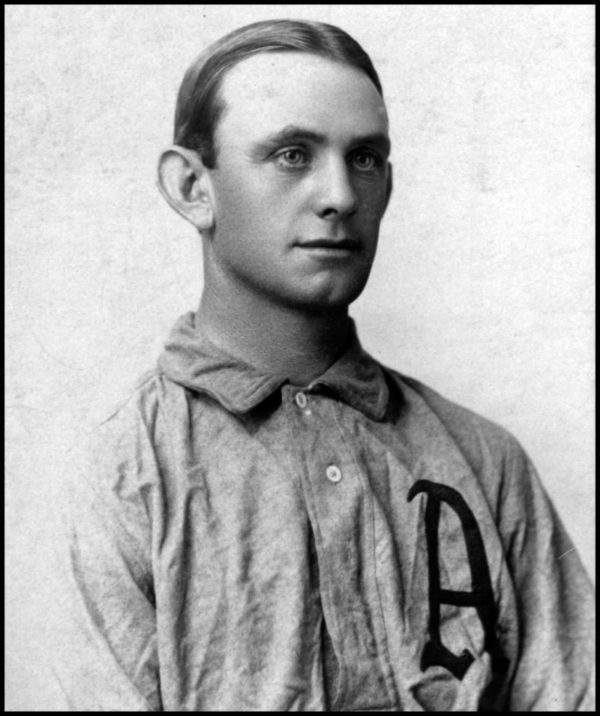
Danny Murphy 1902 Wearing Philadelphia Athletics Uniform

*Place cursor over image to magnify

For more than a decade, Daniel Francis “Danny” Murphy was one of the best and most powerful hitters in the American League, a fine fielder with a strong arm, a savvy base runner, and a pioneer in the art of sign stealing and pitcher reading. He played both second base and outfield, and was appointed captain of his major league team twice: once as a player (1912-13) and later as a coach (1920-24). Born in Philadelphia and having grown up in Providence and nearby SE Massachusetts, he came to Norwich to pursue a professional baseball career.

He had been playing semi-professional baseball in Massachusetts since September 1896. Over the next three seasons he played for a number of semi-pro teams out of Fall River and North Attleboro, earning just a few dollars for a weekend game. A millworker since he was a pre-teen, his baseball talent resulted in a full-time job in a jewelry factory soon after he turned semi-pro.

Danny arrived in Norwich in the spring of 1900. He had been signed to play second base for the Norwich Witches of the Connecticut State League (CSL). The league also included teams from Bridgeport, Bristol, Derby, Meriden, New Haven, New London and Waterbury. Over the three seasons that he played for Norwich he apparently was not paid anymore than $100/month. He eventually would begin supplementing his baseball income with a job at US Finishing Company in Greeneville.

Thanks in good part to Danny’s batting, the team won the CSL championship that first season. He batted .370 and led the league decisively in hits (138), doubles (28), triples (23), home runs (14). The top baseball expert at the Boston Globe reported at the time that he doubted that there was a better prospect in the country than Danny.

Note: If the number of home runs seems low it is because they did not occur anywhere near as frequently as they did in years to come. Two of the big reasons was that the ball was not as lively and the other that the fences at the ballparks were typically further from home plate.

1891-1910 Minor League Baseball in Norwich

The Connecticut League, also known as the Connecticut State League (CSL), was a professional baseball association of teams in the state of Connecticut which dates back as far as 1884. Norwich based teams played in the league during the years 1891 to 1910.

Sachem Park

Present Day St. Joseph’s Cemetery

*Place cursor over image to magnify

YearsTeam Names
1891Norwich
1899Norwich Jackroses
1900Norwich Witches
1901Norwich Champs
1902-1903Norwich Reds
1904Norwich Indians
1905-1907Norwich Reds
1910Norwich Bons

Danny Murphy
1900 Norwich Witches

*Place cursor on image to magnify

*Place cursor over image to magnify

The Witches played at the baseball field at Sachem Park, a public entertainment venue on Boswell Avenue. The park eventually became St. Joseph’s Cemetery around 1920. The team played about 100 games each season.

Following a short stint in the majors Danny returned to the Norwich team in May 1901 and continued his hard hitting: .376 batting average, with 32 doubles, 16 triples and 12 homers. However, the team, which had started out badly in his absence, rebounded to finish narrowly out of 2nd place.


Danny returned for the 1902 season, but moved up to a permanent spot in the majors in early July. During his final months with Norwich, he mounted a 34-game hitting streak and finished with a hefty .462 batting average. It was the highest average in all of professional baseball that season. Unfortunately, the Norwich team suffered without Danny in the line-up — dropping from first to seventh place.

The 1910 Danny Murphy Night in Norwich is discussed in detail in the Historic Events placemark.

While in Norwich, Danny met the love of his life, Catherine Moriarty Murphy. Danny and Catherine were both first generation Irish Americans. Danny was a resident of Norwich during his major league playing days, and later when he managed a minor league club in New Haven.

His wife had grown up working in a Norwich cotton mill, as did several of her sisters. Danny and Catherine had been married 16 years when she died during the 1918 Pandemic at the age of 34. Danny had not remarried when he was buried beside her in St. Mary’s cemetery 37 years later.

Acknowledgements

Thanks to Tom Sullivan for his contributions to this placemark

“Baseball’s Sherlock Holmes: The Biography of Danny Murphy of the Philadelphia Athletics,” (2022), by Tom Sullivan

“Danny Murphy Wearing Philadelphia Athletics Uniform,” (1902), Boston Public Library

“Norwich’s Sachem Park Baseball Field,” Otis Library

Danny Murphy Wearing Norwich Witches Uniform,” (1900), Private Collector

“Danny Murphy, Philadelphia,” (1924), Library of Congress

The complete list of sources may be found by clicking the “Bibliography” button, and, then typing “Danny Murphy” in the SEARCH box.

Lefty Dugas (1907-1997)

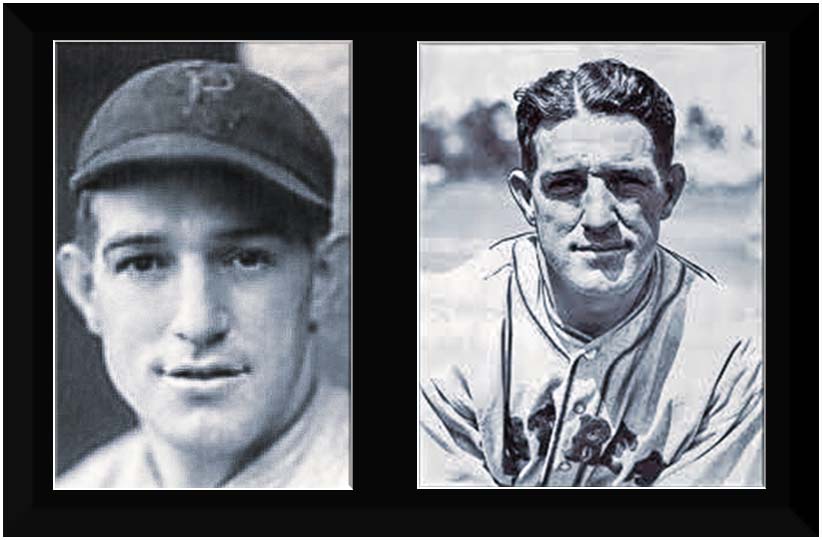
Lefty Dugas was a Major League Baseball player who grew up in the Taftville neighborhood of Norwich. He was an outfielder who batted left-handed and threw left-handed. He played with the Pittsburgh Pirates from 1931 to 1933 then played one year with the Washington Senators. He was also a star for the minor league Montreal Royals. During his minor league career he had a .327 batting average and a .206 batting average in the major league. 

His family moved to Taftville from Quebec when he was two years old. His father worked in Ponemah Mills in Taftville. Lefty was described by Bill Stanley, a former writer and historian, as “a good man — humble, very religious, very caring”.  And when Bishop Reilly first came to Norwich, he described Lefty as a “saint”.

Lefty played baseball for many teams over the years. He first signed with the Pittsburgh Pirates at the end of the 1929 season and was assigned to the Wichita Aviators of the Western League in 1930 where he had a tremendous season, hitting .349 and slugging .565 with 24 doubles, 12 triples and 26 homers in 143 games. The Pirates gave him a look late in the 1930 season and he did well, hitting .290 in 31 at-bats. In his big league debut on September 17th, he went 3 for 5 in a 12-5 win over the Philadelphia Phillies.

On September 28, 1930 he was the first player to face the St. Louis Cardinals’ Dizzy Dean in the future Hall of Famer’s big league debut, drawing a walk and scoring the Bucs’ only run of the game. The French Canadian press took notice of him at that point, and he would become a regular subject of coverage in his native province over the next two decades, even if he never became a household name in the United States.

In 1943, he was back in the International League with the Toronto Maple Leafs, where he hit .283 in 48 games. He then had to give up the game for a few years because of World War II, working those years at Hamilton Standard, a war plant manufacturing aircraft propellers in Connecticut. The Royals were reportedly interested in bringing him back as their manager in those years, but the call of Uncle Sam was stronger. When the war was over in 1946, he played a few games for the Providence Chiefs of the New England League at age 39, hitting .260, then hung up his cleats for good.

Dugas worked for a number of years as an extrusion operator for the Plastic Wire and Cable Co. in Norwich before retiring in 1972. He was a frequent visitor to Quebec in those years, including as a guest of the Montreal Expos when they began play in 1969 and again when they inaugurated Stade Olympique in 1977. The city of Norwich honored him by naming a street in the vicinity of Dodd Stadium “Lefty Dugas Drive”.

He suffered a stroke shortly after his 90th birthday and died less than a month later, on April 14, 1997. He is buried in St. Joseph Cemetery.
Acknowledgements

Baseball-Reference.com

“Norwich Was Home to Its Own Lefty,” (2009), by Bill Stanley

The complete list of sources may be found by clicking the “Bibliography” button, and, then typing “Lefty” in the SEARCH box.

James Selvidio (1916-1980)

*Place cursor over image to magnify

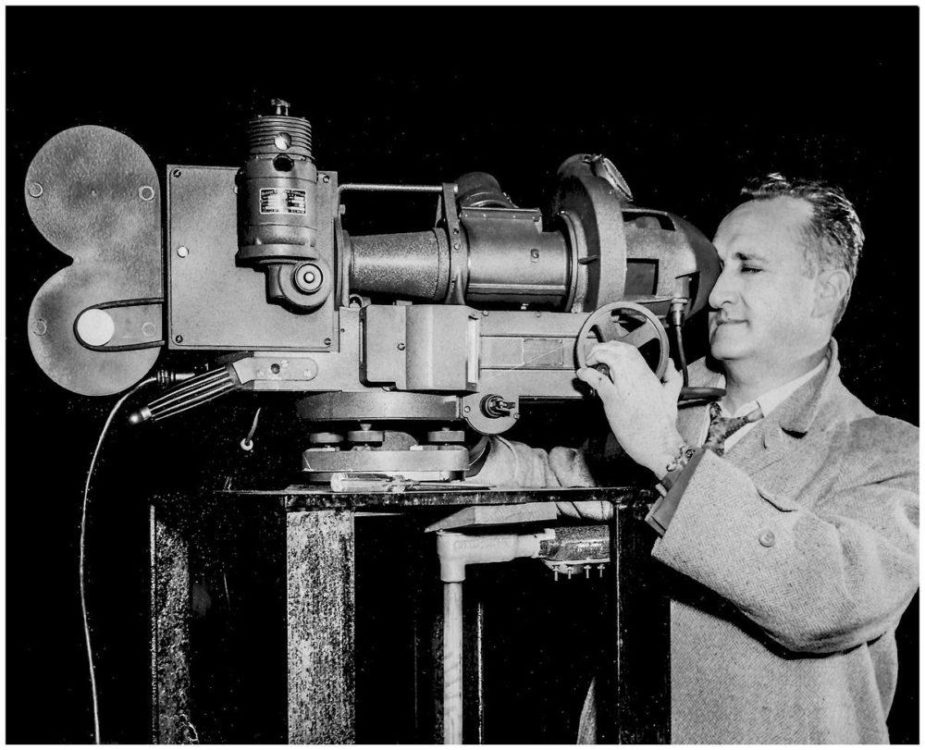
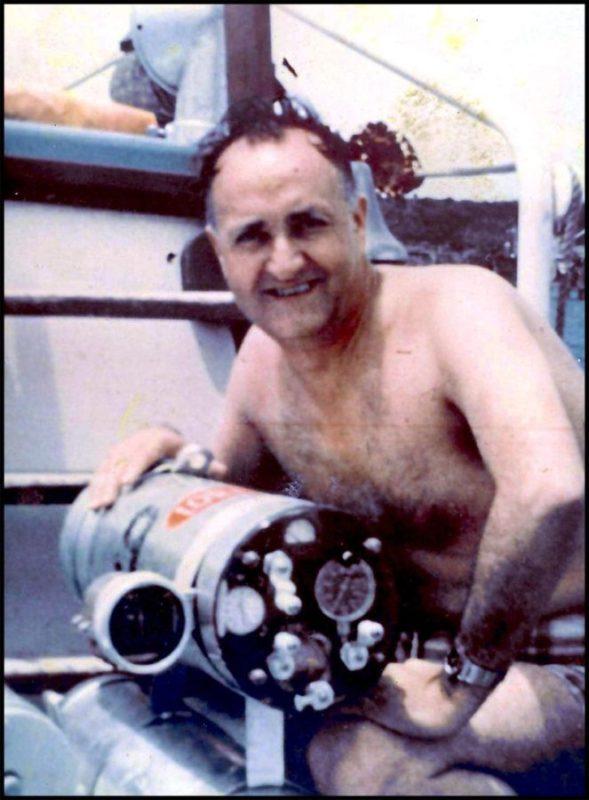
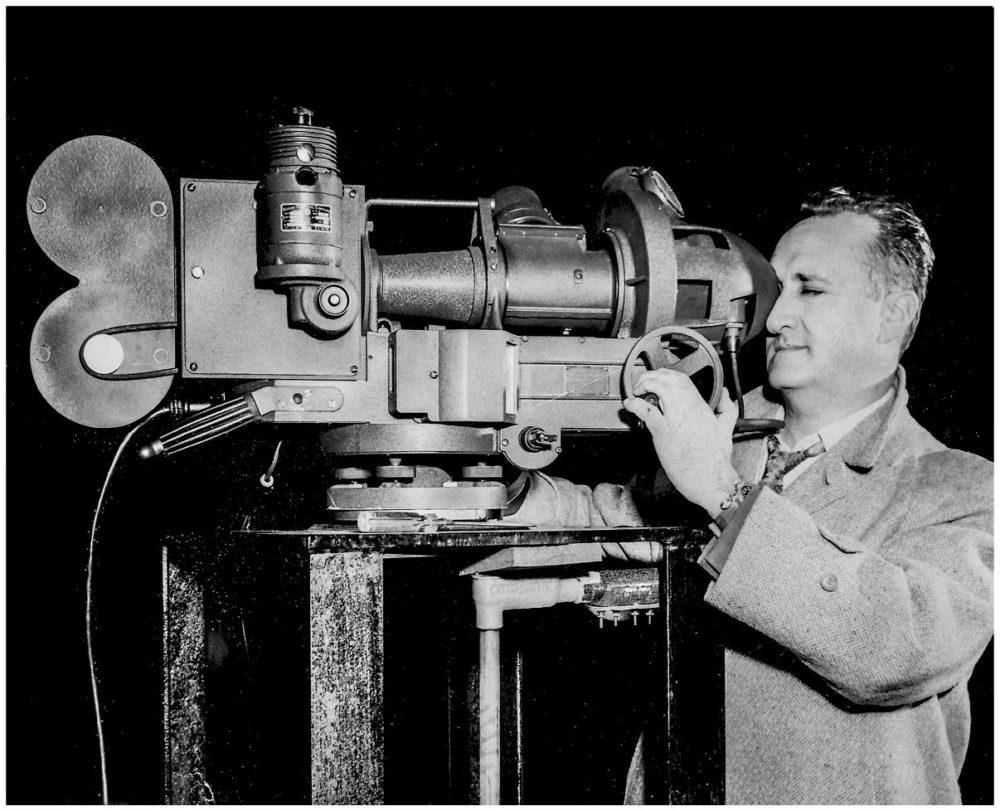
Norwich’s James F. Selvidio was a pioneer in the field of undersea photography and videography. Jim was nationally recognized for his numerous contributions to the field of Video Optics and Video instrumentation.  His served the United States from 1945-1974 at the Naval Underwater Systems Center.

In addition to developing numerous novel photographic instrumentation methods, he supervised a team of underwater research photographers and videographers during the early years of undersea video recording. From 1968-1971 he and his team successfully conducted a deep-water photographic research project that showed how the sea changes over time. They established a closed-circuit video link that communicated with photo equipment 1800 feet beneath the surface. Refer to Info Sources 1 and 2 for details.

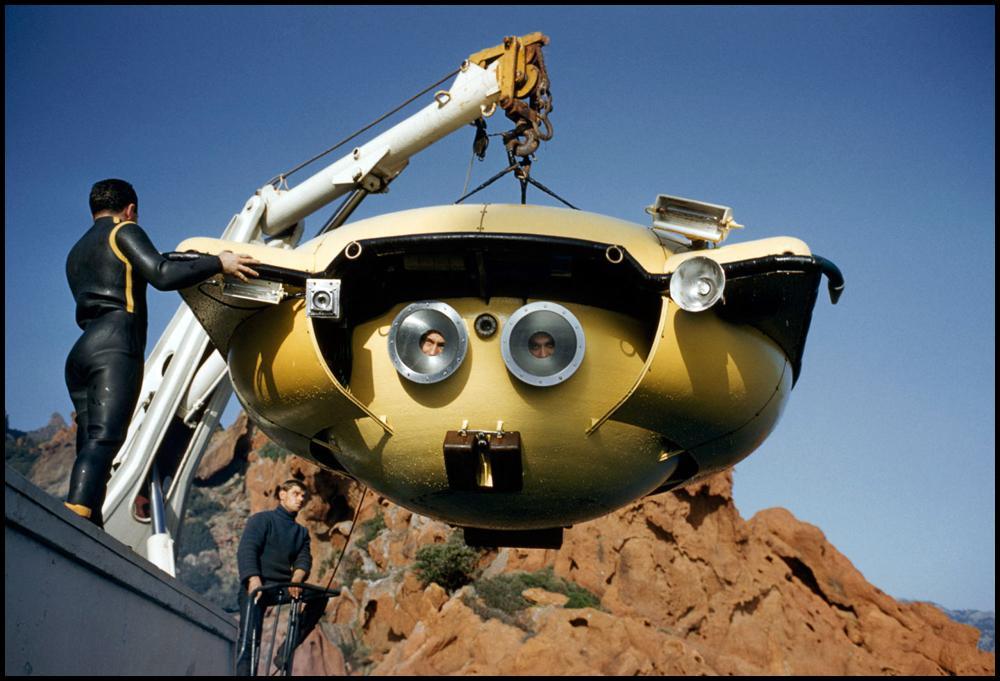
The pinnacle of his career, perhaps, came in 1965 when Jacques Cousteau and his team joined forces with the Underwater Sound Lab and Jim Selvidio’s photography/video team. Cousteau, a former French naval officer, had previously perfected a technique for breathing underwater using his Aqua-Lung (a.k.a. scuba) and had built a small underwater submarine (his Diving Saucer), but needed to learn how to take higher quality photographs and videos in a deep sea environment. It is said that Jim Selvidio was Cousteau’s primary educational source for undersea videography. In future years, Cousteau went on to become a famed underwater researcher, photographer, videographer, and environmentalist.

*Place cursor over image to magnify

JACQUES COUSTEAU’s DIVING SAUCER

Jacques Cousteau’s SP-350, Denise, (a.k.a. Diving Saucer) was used to conduct a series of military and civilian underwater research projects in 1965. These deep water experiments were conducted off the coast of San Diego, California.

Cousteau’s team and his Diving Saucer collaborated with acoustic experts at the United States’ Underwater Sound Lab to collect data to feed the ever increasing need for advancements in underwater Anti-Submarine Warfare detection systems. James F. Selvidio’s team of photographers and videographers collected and recorded this critical data.

A detailed discussion of the team work may be found in Roy R. Manstan’s book, Cold Warriors: The Navy’s Engineering and Diving Support Unit, (2014)

Beginning 1950, Mr. Selvidio contributed more than 30 technical papers in the area of undersea photography.  He authored an introduction to “Holography”, (available in Bibliography) in the late 1960s that describes the science behind holograms and how holograms could be produced. One section of the paper states:

“The U.S. Government is working on using holograms to help transmit data more quickly from satellites and to assist in weather control experiments.” … and  “In the not too distant future, you may be able to watch 3-D movies and television produced by holograms.”

He went on to mention that he witnessed a 4 ½ second 3d movie in August 1965.

James Selvidio enjoyed the benefits of a large family. He had eleven siblings. As an adult, he lived in the west side of Norwich on New London Turnpike with his wife, Caroline Toscano Selvidio, until her death in 1970. They raised four children; Aileen, Barbara, Dawne, and Jeffrey.  

In 1973 Jim married Edith Bowerman Havens.  After his 1974  retirement from the Naval Underwater Systems Center, he moved to Florida. Jim Selvidio passed away in 1980 and is buried alongside his wife Caroline in Norwich’s St. Joseph’s Cemetery.

*Place cursor over images to magnify

Acknowledgements

Thanks to Laurene Shewan for her contributions to this placemark

Jim Selvidio Using a Video Camera, circa 1968

James Francis Selvidio, FindAGrave

“The Sea Change – 300 Fathoms Deep, 3 Years Later,” (1971), by James F. Selvidio

“The Utilization of an Underwater Video System in a Deep Ocean Emplantment,” (1968), by James F. Selvidio

List of Publications by James F. Selvidio

The complete list of sources may be found by clicking the “Bibliography” button, and, then typing “Selvidio” in the SEARCH box.