William Parkinson Greene was born in Boston, the second son of Gardner and Elizabeth Hubbard Greene. William graduated from Harvard in 1814 and began to study law. But his health not being equal to the requirements of the legal profession, in 1824, at the request of William C. Gilman, Mr. Greene came to Norwich, where he became a partner and agent for the Thames Manufacturing Co. at the Falls. By 1833, the Yantic Falls area was thriving, boasting a large cotton mill, two paper mills, an iron factory, a nail factory, and a rolling mill, all of which were in successful operation.
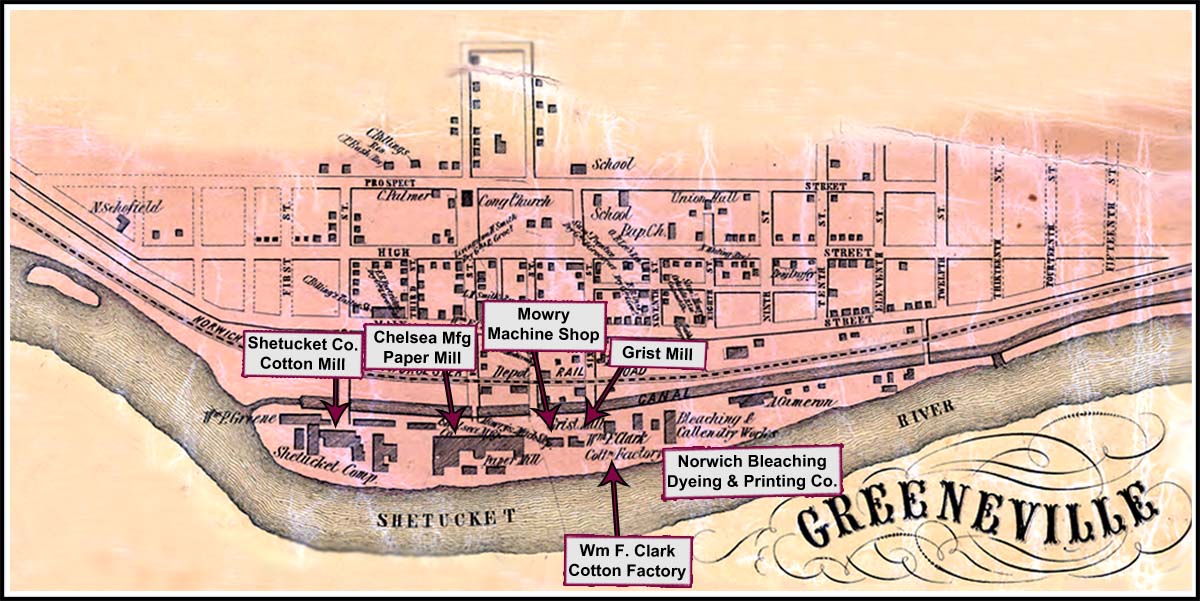
In 1828, Mr. Greene led a group of investors in forming the Norwich Water Company, whose primary purpose was to promote business development along the Shetucket River. Mr. Greene had previously purchased land on both sides of the river for a distance of three miles. The dam was completed, and a canal, forty-five feet wide and nine feet deep and seven-eighths of a mile long, was built, and the village to be named Greeneville was laid out. Soon, factories for the production of cotton goods, paper, flannel, and carpets sprang up, and the town of Greeneville came to life. Between 1838 and 1842, William Greene formed the Shetucket Company, which built and operated the great cotton mill in Greeneville (which employed 450 people and had an annual product value of $400,000) and the Falls Company to manage the cotton mill at Yantic Falls. Over time, the Falls Company was able to acquire smaller companies and soon tripled in size.
In addition to his mill operations, William Greene was a founder and the first elected president of the Thames National Bank, which was chartered in 1824 and incorporated the following year with a capital of $200,000. In April 1861, at the beginning of the Civil War, Governor Buckingham, a friend and customer of the bank, appealed to the institution for assistance. The bank at once took the lead in this direction, and voted, “that to assist the State in meeting the requisition of the President of the United States for troops for the maintenance of the general government, the Thames Bank offer a loan of $100,000,” which was duly deposited into the treasury of the State of Connecticut. William Greene was also the mayor of Norwich for one year. For health reasons, he declined all other appointments for public office. He was, however, the second president of the Board of Trustees for the Norwich Free Academy. William Greene’s health steadily declined, and he died at the age of sixty-eight in June 1864.
Seldom has the death of a citizen of Norwich evoked in this place such deep emotion and such profound regret. The loss was felt in the circles of those in business, government, education, and philanthropy.
References