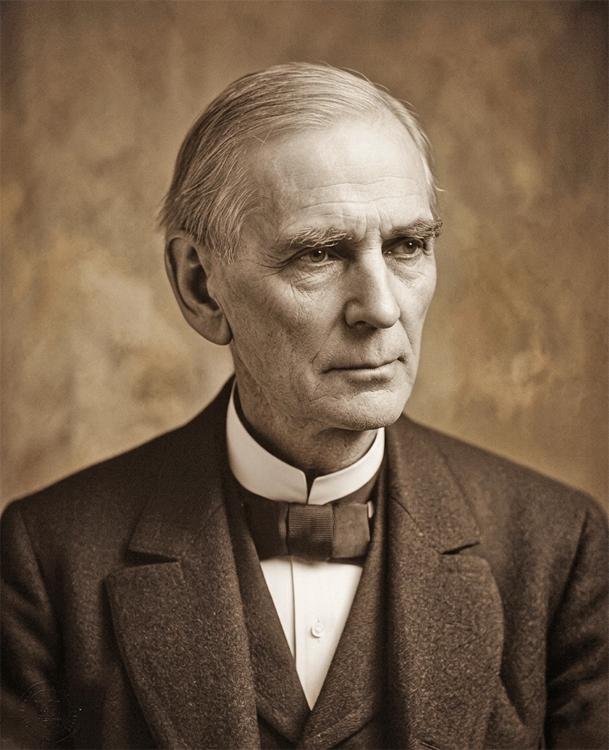
The Hon. Jeremiah Halsey, LL.D., was one of the most honored attorneys to practice in New London County. He was born in Preston, CT, in February 1822, a son of Jeremiah S. and Sally (Brewster) Halsey. Educated in local Preston schools and for a time at Norwich Academy, he had intended to continue his education at Yale, but ill health ended that prospect, and he headed south in pursuit of a milder climate.
Jeremiah continued his training as a law student with a Georgia law firm and, in April 1845, was admitted to the bar in Georgia. He was later admitted to the bar in Windham County in December. By 1849, his health had improved enough that he opened a law office in Norwich, CT, with Samuel Morgan, where he began his celebrated career. Halsey’s skills and confidence continually improved so that in a short time, he was ranked among the top lawyers in the state.
In 1863, he was admitted to the bar of the U.S. Circuit Court, and in 1870, to the Supreme Court of the United States. In 1852–53, he represented Norwich in the State Legislature, and again in 1859-60. In 1865, the Norwich Board of Trade listed Jeremiah Halsey among the wealthiest men in Norwich, with an annual income of $5,795 ($120,000 in 2026$). In 1873, Gov. Ingersoll appointed him to supervise construction of the new statehouse in Hartford. In 1853, Halsey was made city attorney and served for 15 years.
He was a trustee for the Norwich Free Academy, a member of the advisory council of United Workers, trustee and council member of the Norwich Savings Society, director of the First National Bank, council member for the Chelsea Savings and Thames Savings Banks, a director of the New London Northern Railroad Company, and one of the original incorporators of the Huntington Memorial Home.
Jeremiah Halsey married Elizabeth Fairchild of Ridgefield, CT, in 1854. He was an active member of Christ Episcopal Church. Halsey died at the Hamilton Hotel in Washington, D.C., in 1896.
Judges and lawyers admired him as a brilliant member of their profession, and they respected him as a man among men.
Reference