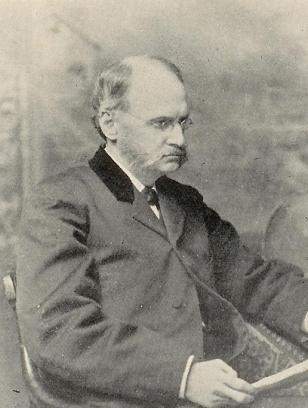
David Wells was born in June 1827 in Springfield, Massachusetts. He graduated from Williams College and, in 1848, became associate editor of the Springfield “Republican,” where he invented a device to fold papers. He was appointed assistant professor at the Lawrence Scientific School at Harvard University in 1850. In 1852, he received his B.S. from Harvard, and in 1863, he was awarded the honorary degree of M.D. from Berkshire Medical College. Mr. Wells was affiliated with the book publishing company, G.P. Putnam & Co. of New York, for a time. Between 1857 and 1863, he wrote a series of scientific schoolbooks that were widely circulated. West Point adopted his book on chemistry as its standard textbook for chemistry.
During the Civil War years, David Wells wrote a pamphlet describing the financial strength of the Federal Government and its ability to defray the cost of the war for an indefinite period. It was entitled “Our Burden and Strength.” It bolstered confidence in the financial strength of the Federal Government and became “the” excellent pamphlet of the Civil War. It met with such popularity that several hundred thousand copies were printed and circulated throughout this country and Europe. As a result, and at the request of President Abraham Lincoln, Mr. Wells met with the President in February 1865 to discuss the most effective method for using taxation to raise federal revenues and pay the interest on the country’s mounting war debt.
Following their meeting, Lincoln appointed Wells as chairman of the National Revenue Commission in 1865. Mr. Wells’ recommendations, which became law in 1866, included lowering the tax on domestic distilled spirits from $2.00 to 50 cents per proof gallon. As a result, revenue rose from $18,655,000 in 1868 to $45,071,00 in 1869 and $55,606,000 in 1870.
President Andrew Johnson, who succeeded Lincoln, made David Wells a special commissioner of the revenue. The Reports of the Special Commissioner of the Revenue, 1866-69, recommended the use of stamps in the collection of revenue on liquor and tobacco. After studying the economic advantage workers in the United States had over those in European countries, David Wells became an advocate for “free trade.” He was an advisor to his close friend, Congressman James Garfield, on tariff matters, and later to Grover Cleveland. As chairman of the New York State Tax Commission, he presented a highly influential analysis of the problem New York was experiencing in losing business to neighboring states with lower taxes. Mr. Wells was also an active consultant to the railroad industry and served as a delegate to the Democratic National Conventions. He ran unsuccessfully for Congress from Connecticut in 1876 and 1890, and he delivered many speeches in support of each of Grover Cleveland’s campaigns.
Wells wrote extensively on current economic issues, especially on tariffs, the theory of money, and taxation. His goal was to achieve greater efficiency by progressively lowering the costs of production through the application of science. The creation of a Federal Bureau of Statistics in the Department of the Treasury was primarily due to Wells’ influence. He was the foremost American authority on the economics of the emerging “machine age” and, as a result, was awarded the French gold medal at the 1869 French Exposition for his contributions to economic literature. David Wells also received honorary degrees from Oxford, Williams College, and Harvard University.
Wells died in November 1898 at Norwich, which had been his residence since 1870. He was married on May 9, 1860, to Mary Sanford Dwight, by whom he had one son; a second wife and a son also survived him.
Reference