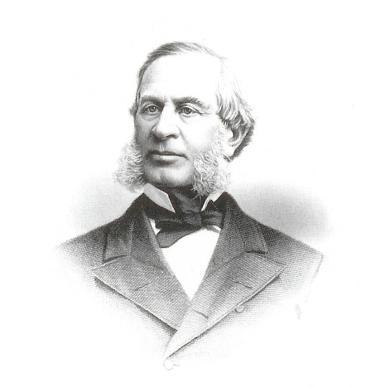
John F. Slater, the son of John Slater (Samuel Slater’s brother and partner), was born in March 1815 in Slatersville, RI. He was educated in academies at Plainfield, CT, and Wrentham and Wilbramham, MA. In 1831, John Slater’s father purchased his brother Samuel’s share in their Jewett City cotton mills. He thereafter sent his son, John Fox Slater, to assist in the mill’s management and to oversee operations at a small mill at Hopeville, about three miles away, that John Slater, Sr. had purchased in 1825.
On the death of John Slater, Sr., in 1843, his two sons, John Fox and William S. Slater, inherited his business properties. In 1849, the brothers purchased the interests of Samuel Slater’s heirs in Slatersville. In 1853, they decided that William S. Slater should oversee the Slatersville mills, and that John Fox Slater should continue managing the Jewett City and Hopeville mills. They operated these properties under the name J. & W. Slater until 1872, when the partnership was dissolved; each brother then gained ownership of the mills under his charge. John Fox Slater made many improvements to his Jewett City mills, and his activities had a considerable impact on the community.
John F. Slater was succeeded by his son William A. Slater in 1884. Two years later, the Great Freshet of 1886 destroyed most of the dams along the Pachaug. The Slater mills were inundated, resulting in production loss for many months, and more than $150,000 was spent on repairs. This crisis was surmounted, and by 1896, the company’s most prosperous period, 700 looms and 19,000 spindles were operating, providing employment for 500 people. The major products were stripes, plaids, flannels, dress goods, and fancy colored goods.
In 1842, John Slater moved from Jewett City to their mansion at 352 Main Street in Norwich. In 1865, the Norwich Board of Trade listed the annual income of John Slater at $104,269.
In 1867, the Taft brothers were well along in the process of constructing their mills when they encountered financial difficulties and were forced to look for assistance and reorganize. John F. Slater, Edward Chappell, and Lorenzo Blackstone became involved in the project. In 1871, the mill became known as Ponemah Mills (an Indian word meaning “our future hope”). The combined buildings had a frontage of 1,400 feet and, at the time of construction, were considered the largest cotton manufacturing plant in the world.
While in Norwich, John Slater helped to endow the Norwich Free Academy. In 1882, he donated to a board of ten trustees, incorporated in New York state, $1,000,000 to be used for the education of freed blacks in the southern states. Among the original trustees of the Slater Fund were Rutherford B Hayes, Morrison R. Waite, William E Dodge, Phillips Brooks, Daniel Coit Gilman, Morris Ketchum Jesup and the donor’s son, William A Slater; and among members chosen later were Melville W. Fuller, William E. Dodge, Jr, Henry Codman Potter, Cleveland H. Dodge and Seth Low. By 1909, the fund had increased, despite expenditures, to more than $1,500,000 through careful investment. The fund has been of great value in aiding industrial schools throughout the South. For this far-sighted act of philanthropy, John Fox Slater was posthumously awarded a Congressional Medal of Honor.
John Fox Slater died in Norwich in May 1884.
In 1884, John Fox Slater’s son, William A. Slater, wishing to honor his distinguished father, made a generous donation to the trustees of Norwich Free Academy for the creation of a new building that would bear his father’s name. Part of the building would house a museum and art gallery.
References