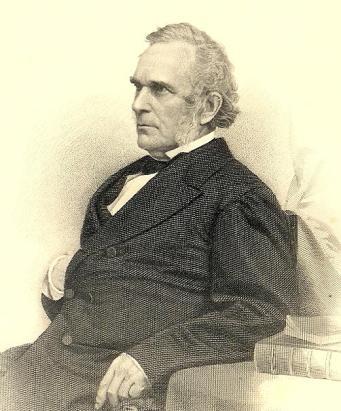
William Buckingham was born in Lebanon, CT, in May 1804. He is a direct descendant of Rev. Thomas Buckingham, minister of Saybrook and one of the ten founders of Yale. His family home can still be seen on Rt. 8 as it runs through the town. He is a descendant of a family of Puritans, who left England and migrated to America in 1637. He was educated initially in local public schools and later graduated from Bacon Academy in Colchester. When not in school, he worked on the family farm, where the stone walls he built are still present. At eighteen, he began his career teaching in a district school in Lyme, but after one year, William relocated to follow a new vocation. At age twenty, he entered a dry goods business in Norwich, CT, as a clerk. After a few years there and some time in a wholesale business in New York, William opened a dry goods store in Norwich, which met with immediate success. In 1830, he began manufacturing ingrain carpets. The business proved to be very profitable, and he continued in it for the next eighteen years. In 1848, William divested himself from his previous company and invested in the manufacture of India-rubber goods, becoming the treasurer and a director in the Hayward Rubber Co. Subsequently, he became interested in several additional manufacturing enterprises. As a man of business, William Buckingham was distinguished for industry, integrity, and promptness. He uniformly fulfilled his engagements, and his credit was unquestionable.
Buckingham’s home is located at 307 Main Street in Norwich, now across the street from the Chelsea Groton Savings Bank. In September 1830, William married Eliza Ripley, daughter of Dwight Ripley of Norwich. Eliza died in April 1868, leaving his home and heart desolate. His only son, William Ripley, died in early childhood, and his surviving daughter, Eliza Coit (born 1838), married William A. Aiken in 1861. Both lived in Norwich. William served on Gov. Buckingham’s staff as quartermaster general during the Civil War.
The Buckinghams were active members of the Second Congregational Church and, following its destruction by fire, were advocates and generous benefactors for the building of a new church in 1842, now the United Congregational Church. William was a communicant and taught Sunday school for thirty-seven years, excepting four years during the Civil War.
In public office, William Buckingham was elected Norwich’s Mayor four times. In 1858, he was elected governor, first by a narrow margin and later by increasingly larger majorities, and served in office for eight years. No one at the time could have predicted that this office of simple routine would soon be transformed into a post of the most serious responsibility. But in review, it can be said with confidence that William Buckingham, from the earliest beginnings to the Civil War’s bitter end, fulfilled the responsibilities and duties as war Governor and represented the state of Connecticut in a manner which was superior to all others.
Governor Buckingham was a patriotic man, for example, when the state treasury was empty and money couldn’t be raised for months by regular methods. William pledged his private credit to fill the gap. President Lincoln at one time told a visitor who was from Connecticut, “Do you know what a fine governor you have?” In 1866, Buckingham resigned as governor and was elected to the United States Senate in 1868, where he continued to serve the people of Connecticut until he died in 1875.
Following his death, Buckingham’s home was bequeathed to the Civil War Veterans and named The Buckingham Memorial, Sedgwick Post, No.1
An additional point of interest: due to his friendship, William personally invited the then-candidate for president, Abraham Lincoln, to visit Norwich. Lincoln addressed residents and stayed at the Wauregan Hotel.
References