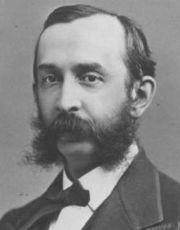
Daniel Gilman was born in Norwich in July 1831. He was the fifth of nine children of William C. Gilman, a wealthy mill owner. He graduated from Yale in 1852 with a degree in geography. For a time, Mr. Gilman served as the attaché of the United States legation in St. Petersburg, Russia. Afterward, he returned to Yale and played a pivotal role in founding the Sheffield Scientific School. He was Yale’s librarian from 1856 to 1865 and was appointed professor of geography at the Sheffield Scientific School.
In 1872, he left Yale to become the second president of the newly formed University of California. Then, in 1875, he was selected to become the first President of Johns Hopkins University. His formal inauguration, on February 22, 1876, has become Hopkins Commemoration Day, a day on which many university presidents now choose to be installed in office.
While at Johns Hopkins, Daniel Gilman developed an advanced program of study that is followed today by many colleges and universities, known as the graduate school. Mr. Gilman played a pivotal role in establishing the Johns Hopkins Hospital in 1889 and the Johns Hopkins Medical School in 1893.
He began the practice of requiring a college degree as a stipulation for entrance into the college, a practice that all other medical schools soon adopted. Daniel Gilman retired in 1901 but was later appointed to the presidency of the Carnegie Institution in Washington, D.C.
Following his death in 1908, the main academic building at Johns Hopkins University was named Gilman Hall in his honor. Additionally, at UCLA (Berkeley), Gilman Hall, the oldest building of the College of Chemistry and a National Historic Chemical Landmark, was also named in his honor.
Reference
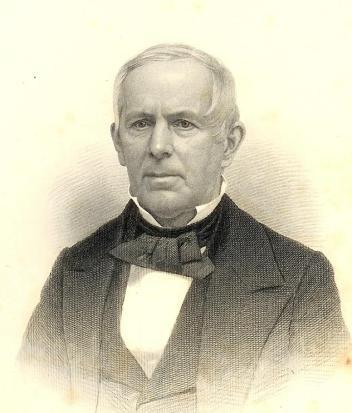
William C. Gilman was born in 1795 in Exeter, N.H. He soon moved to Boston, where he pursued a successful career in the mercantile business for many years. In 1816, Mr. Gilman moved to Norwich. Immediately foreseeing the financial opportunities available in the Yantic Falls area, he purchased a section of land along the river, previously owned by Goddard and Williams, and had a nailery built.
In his factory, Mr. Gilman had installed one of the first automated nail-cutting machines in the country. While in operation, folks would regularly come from all around to listen to the “clink” of the machine and watch the finished nails pile up in the collection barrels. In 1824, William Gilman invited William P. Greene, also of Boston, to settle in Norwich. They formed a partnership that gave rise to the Thames Manufacturing Company and the Norwich Falls Company, both of which operated cotton mills.
Mr. Gilman was the first president of the Norwich & Worcester Railroad, which was capitalized in 1836 at $2,825,000. He also served as president of the First National Bank of Norwich.
He was the mayor of Norwich from 1839-1840.
As a businessman, William Gilman was highly perceptive and could quickly identify business opportunities, accurately presenting them to others. He consistently persevered in promoting plans and projects calculated to develop the resources or advance the moral and religious interests of the Norwich community he loved.
William Gilman is credited with planning the industry that led to the establishment of Greeneville.
The “Panic of 1837″ caused the failure of many smaller businesses at the Falls, and eventually led Mr. Gilman to leave Norwich around 1845, where he settled in New York, spending the remainder of his life. He died in June 1863, and his remains were brought back to Norwich for interment.
References
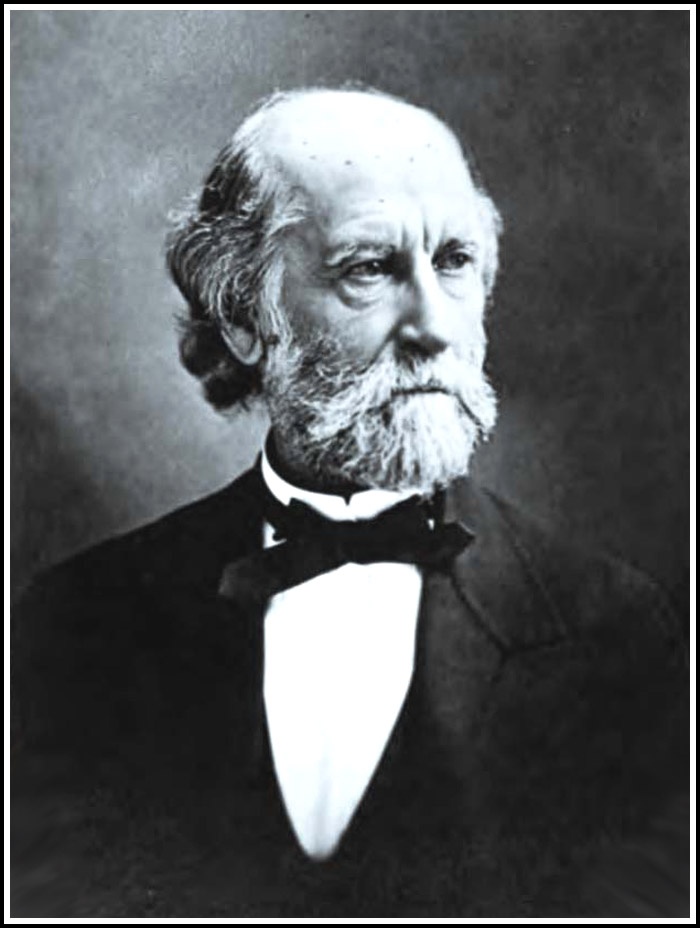
Lafayette Foster was born in Franklin, Connecticut, in November 1806. Following his graduation from Brown University, he became a lawyer practicing in Norwich for over 30 years. He was elected mayor of Norwich in 1835 and 1852, and he represented the city in the General Assembly for six terms. He was also elected speaker of the Connecticut House of Representatives for three of those terms. Foster later became a United States Senator, serving for eleven years. On March 6, 1865, the 39th Congress elected Lafayette Foster President pro tempore of the US Senate.
Six weeks later, following the assassination of Abraham Lincoln, Andrew Johnson, the Vice President, advanced to become the new President, and Lafayette Foster, the President of the Senate and de facto Vice President of the United States (April 15, 1865)—a position he held for almost two years. In 1870, he was elected to the Supreme Court of Connecticut, where he served for six years before retiring due to the mandatory retirement age. He returned to Norwich, where he continued his prestigious and successful law practice.
Lafayette Foster’s home was located on Washington Street off Chelsea Parade. Today, it is commonly known as the Norton Peck Memorial Library, located on the campus of the Norwich Free Academy. The Norwich Board of Trade included Lafayette Foster on their 1865 list of the wealthiest men in Norwich with an annual income of $7,843.
Foster married first, Joanna Boylston Lanman, in October 1837. They had three children, all of whom died in early childhood. Joanna died in 1859.
Foster remarried in 1860 to Martha Prince Lyman. The couple had no children. Lafayette Foster died of malaria in 1880.
References