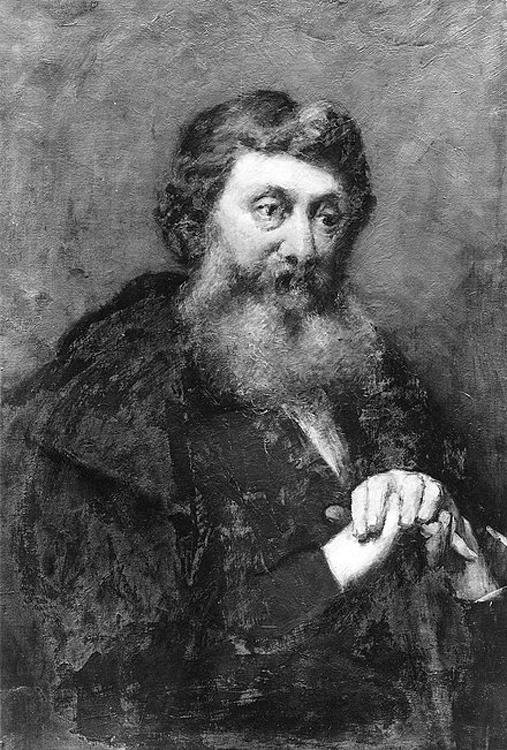
William Henry Huntington was the youngest of nine children born to Charles P. and Maria Perit Huntington on Washington Street in Norwich, Connecticut. His early education began at a local “dame school,” followed by Miss Goodale’s East District schoolhouse in Norwichtown, where he formed a lifelong friendship with Donald Grant Mitchell. Although he left Norwich to study at Wesleyan in Middletown, Connecticut, in the late 1830s, he grew homesick for his family and hometown, and eventually transferred to Harvard in 1841.
Following his college years, Huntington briefly lived in Boston, where he may have worked as a druggist. He rejected a traditional mercantile career early on, choosing instead to serve as a book agent and confidant to his famous author friend, Donald Grant Mitchell. Between 1841 and 1855, Huntington frequently bounced between Boston, New York, France, and his beloved Norwich, before permanently relocating to Europe by 1857 to establish his own professional path.
In Paris, Huntington carved out a highly successful career as a foreign correspondent for Horace Greeley’s anti-slavery newspaper, The New York Tribune. Operating as a dedicated writer and agent, he was a key figure among the prominent, anti-slavery American expatriates living in France. His journalism was particularly notable during the volatile Siege of Paris (1870–1871), during which he reported on the starving populace and quietly donated his own funds to the mayor of Montmartre, Georges Clemenceau, to help aid the suffering city.
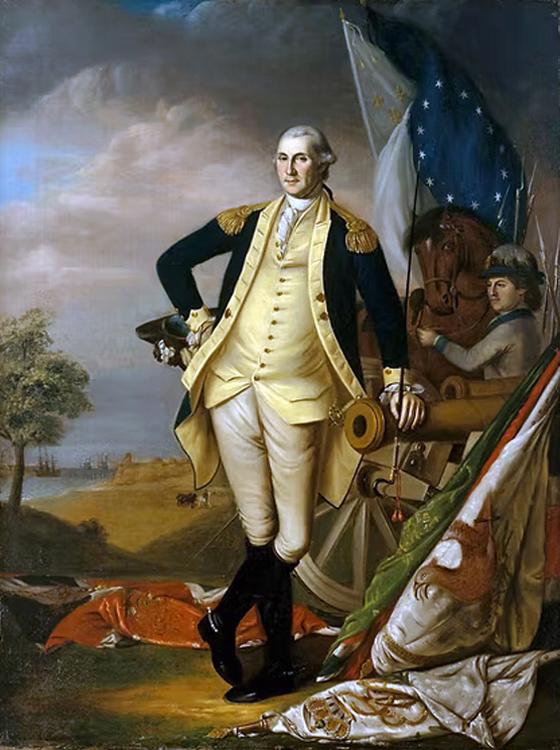
Washington circa 1782 Artist: Charles Peale
Beyond his writing, Huntington supported himself through inherited family wealth and his work as a specialized art and manuscript agent. He was a passionate collector of Early Americana and Founding Father art, famously acting as an agent to help his close friend John Bigelow purchase Benjamin Franklin’s re-discovered autobiography and an iconic DuPlessis pastel portrait of Franklin. His home on the Rue de la Bruyere in Montmartre became a vibrant salon for a distinguished circle of international diplomats, artists, and writers.
Upon his death in Paris in 1885, Huntington generously bequeathed his massive collection of Early Americana and a sum of $50,000 ($1.7 milion in today’s $) to the Metropolitan Museum of Art in New York. As a part of his collection, he bequeathed the copy of George Washington’s portrait shown here to the Met.
On his deathbed, he was cared for by his close friend Estelle Doremus, after which his body was shipped back across the Atlantic. In a final, enduring connection to his roots, he was returned to Norwich and buried in Yantic Cemetery, resting directly across the street from the very home where he grew up.
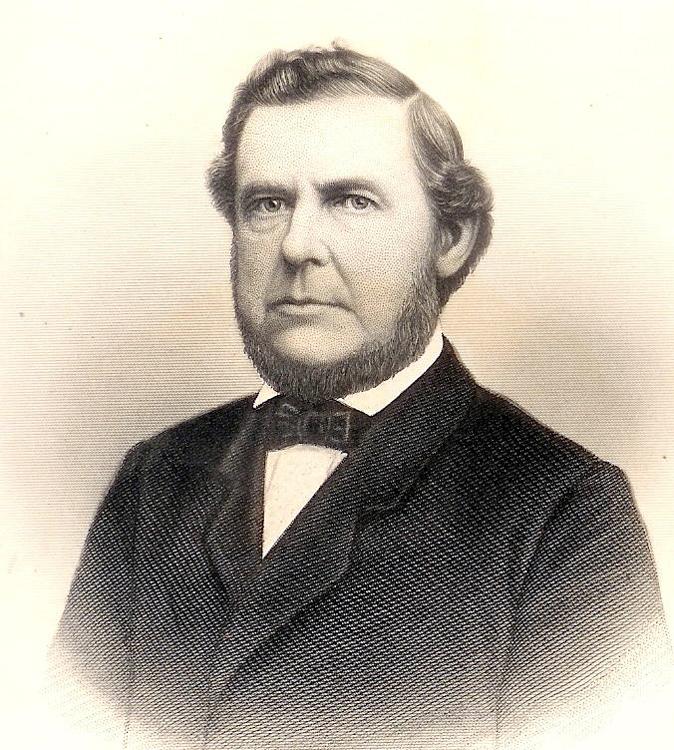
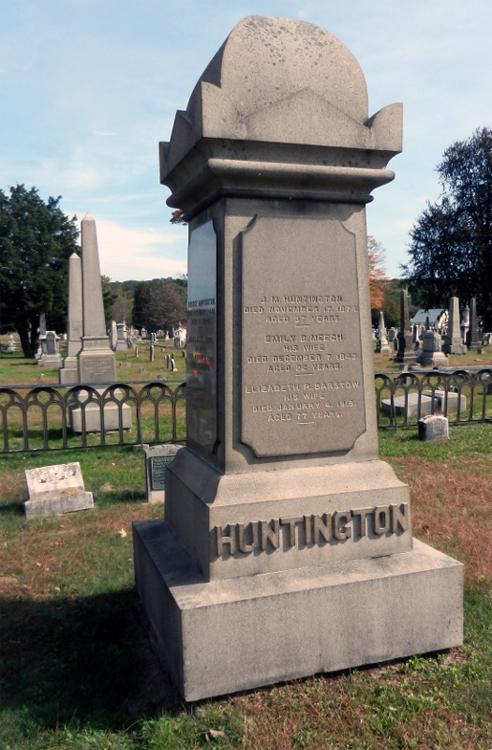
James Monroe Huntington was born in Norwich on August 8, 1817, and to a large degree inherited the virtues and ennobling characteristics of his illustrious ancestors, whose names have ever been synonymous with integrity, uprightness, and a devotion to the best interests of society. He was educated in his native town and began his business career as a clerk for the late A. F. Gilman, who ran a drug business in the building now occupied by Lee & Osgood.
At age 20, he was admitted as a partner, and when Mr. Gilman retired in 1840, James formed a new partnership with the late Jedediah Leavens. In 1844, the firm removed to the wharf, in the building occupied by Charles Osgood & Co. In 1846, Mr. Leavens retired from the firm, and a new partnership was formed, consisting of J. M. Huntington, Theodore Raymond, and James M. Meech, which continued until 1850, when Mr. Meech retired. The firm then moved to Commerce Street, where they engaged in extensive business enterprises and became widely known throughout this section of the country.
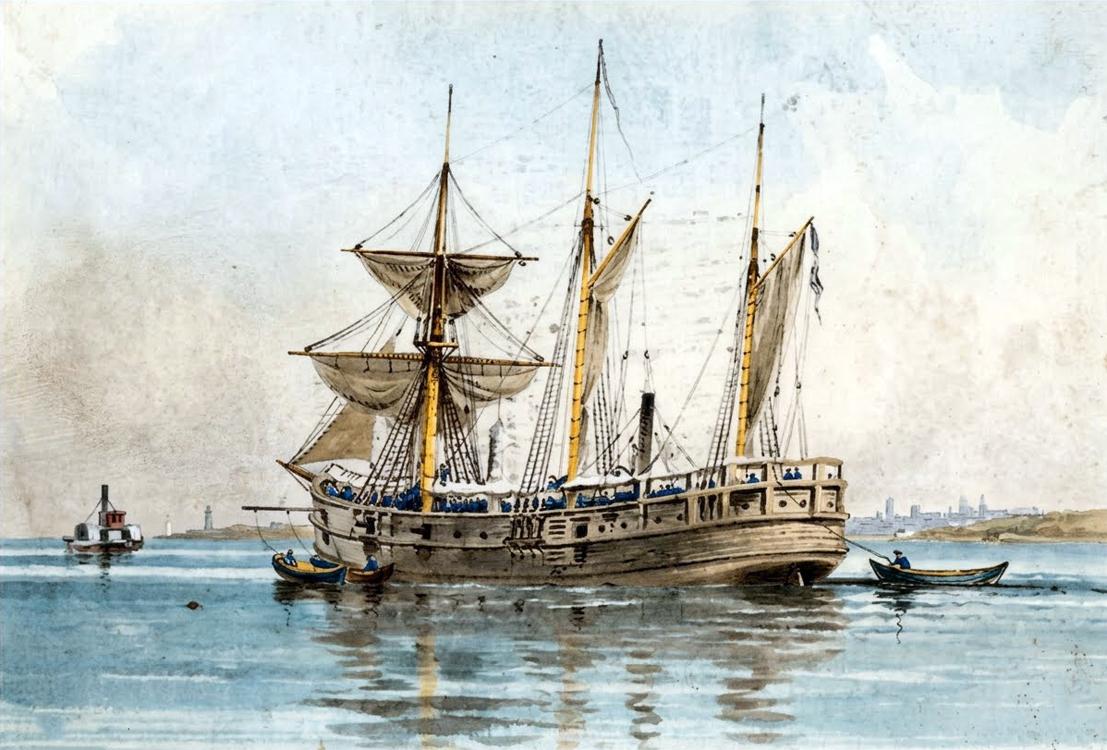
The USS Norwich was built in Norwich in 1861
In 1856, the firm purchased the Cold Spring Iron-Works, which was subsequently sold to the Mitchell Brothers. Huntington and his partners, John Mitchell and his brother Thomas, commenced shipbuilding in Thamesville. They built eleven vessels, nine of which were steamers, constructing not only the hulls but also the entire machinery.
Three of these steamers, the Uncas, the Norwich, and the Whirlwind, were in the service of the government during the Civil War. They were also interested in the West India trade, owning a wharf and bonded warehouse in New London. One of their steamers, the Whirlwind, was the first American merchant steamer to enter the port of Puerto Rico.
In 1852, the firm held a contract to transact all the coal business over the Norwich and Worcester Railroad, with an extensive coal yard and business in Worcester, Massachusetts.
* Place your cursor on the photo to magnify
Mr. Huntington was also interested in the cotton and woolen manufacturing business from its infancy in Eastern Connecticut to the outbreak of the Civil War. He was also interested in manufacturing in Worcester, Massachusetts, and furnished machinery for nearly all the arsenals in the country during the war.
In 1866, this firm established a line of passenger and freight steamers from Providence to Philadelphia, and, in fact, there is not a port of any importance from Newfoundland to Mexico that their vessels did not visited.
James M. Huntington was in all respects an ideal merchant, combining boldness of conception with unusual care and clearheadedness in planning, and uncommon skill in mastering and managing details. Upright and honorable in all his dealings with his fellow-men, it was often, and of truth, said of him that his word was as good as his bond. Stern integrity was born in him, a legacy of his Puritan ancestry, and what he exacted from those who had business relations with him he was equally scrupulous to accord to others. United with his indomitable energy was an inflexible will and unflinching courage that no obstacle could turn aside, and no disaster could daunt.
In religious matters Mr. Huntington was a Congregationalist, and politically a Republican.
On October 11, 1841, James married Emily Brewster Meech, who died Dec. 11, 1843, leaving one child. He remarried on November 24, 1846, to Sarah G. Burgess, of Plainfield. She died November 14, 1864. He was again married, December 14, 1865, to Elizabeth R. Barwtow, of Norwich, who survived him.