1749-2021: Christ Episcopal Church ~ Norwich
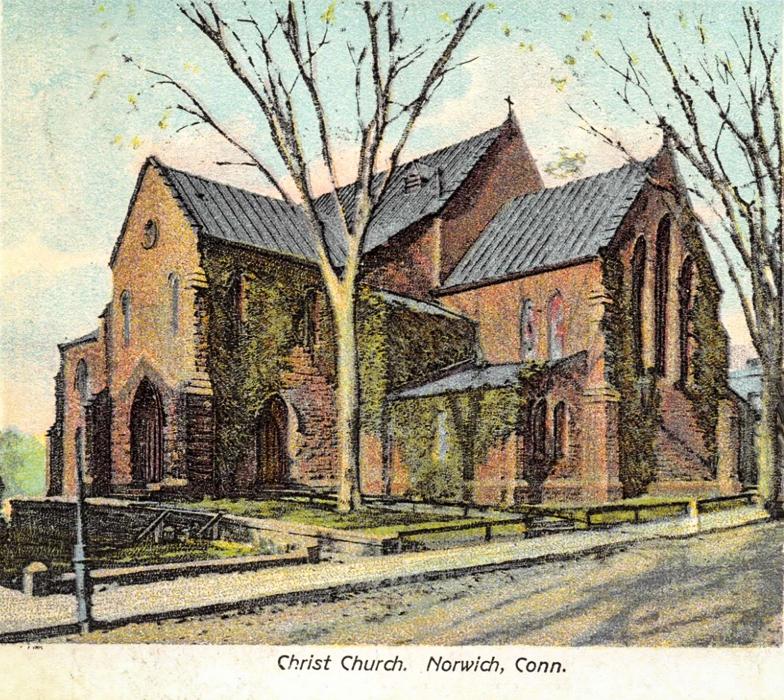
Christ Church ~ 1903 Postcard
The early Anglican parishes in Southeastern CT were based on core principles of the Church of England. Their first church in Norwich was founded in 1746. Its edifice “edifice” is another word for “church building” was erected on Washington Street circa 1749.
In 1791, the parishioners moved their worship services to a more central location. Their original wooden building was dismantled, enlarged, and subsequently rebuilt in the Chelsea district of Norwich.
Later, in 1846, the parish returned to its original place of worship on Washington Street, and a magnificent new church building was erected.
The parish held services from 1846 to 2021 at the building on Washington Street.
*Place cursor over images to magnify
Timeline of Christ Episcopal Church Events
1746: Captain Benajah Bushnell (1681-1762), an 18th-century Norwich merchant, donated land for the site of a church edifice. The area became known as the “Bushnell Site,” disccussed below. Shortly thereafter, a meeting was held at the townhouse to decide matters relative to the erection of an edifice “for the service of Almighty God.” Officers were appointed, and 87 people agreed to donate funds to build the church.
1749: The building was erected on the Bushnell site, with the number of pew-holders being twenty-eight. Parishioners built their own pews and held them as their property.
1749-1751: Reverend Ebenezer Punderson (1705-1764) served for two years as the parish’s first officiating clergyman.
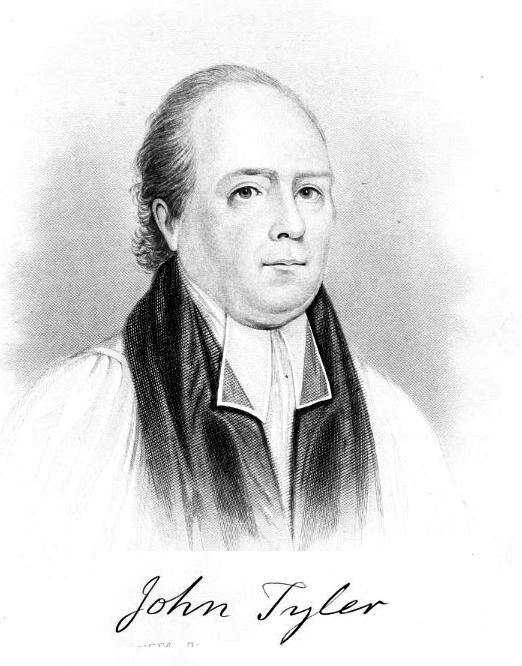
1769: After being ordained in London, John Tyler became the church’s first rector. The first child he baptized was Theophila Grist on September 3, 1769.
Early 1770s: Public opinion made it necessary for the Episcopal the term “episcopal” indicates that parishes are overseen by Bishops clergy in America to either omit the prayers for the King and Parliament from their liturgy or suspend their public services. Reverend Tyler and his followers chose the latter course.
April 1776-April 1779: The locals, largely Congregationalists, saw Rev. Tyler as a kind man and a dedicated healer regardless of affiliation. When threats arose to harm him and other Anglicans, cooler heads prevailed, and they were left in peace. There were incidents of a stone hurled through a window and the rumor that someone had poisoned, or attempted to poison, the well of Reverend Tyler’s house. However, no harm actually came from it, even if that had indeed happened.
Due to threats by American, independent-minded Norwich residents to tar and feather Reverend Tyler and other parish members, the parish suspended public services at the church building. They continued to celebrate the liturgy in secret in Reverend Tyler’s and others’ homes.
1780: With the arrival of the peace, under the dedicated hand of the Reverend Tyler, the church began to grow its congregation again. Much-needed repairs to the church, including the addition of a porch, a bell, and a steeple, were made.
1785: The designation of “Christ’s Church in Chelsea” first appears on record.
*Place cursor over image to magnify
1789: Following the end of the American Revolution, the “Episcopal Church of the United States” was formed in Philadelphia. This new denomination was independent of the former Church of England. The separation was a political decision to create a self-governing church in the new country, as the English monarch was no longer a suitable head for the church.
1789: The parish decided to move its building to a more convenient location.
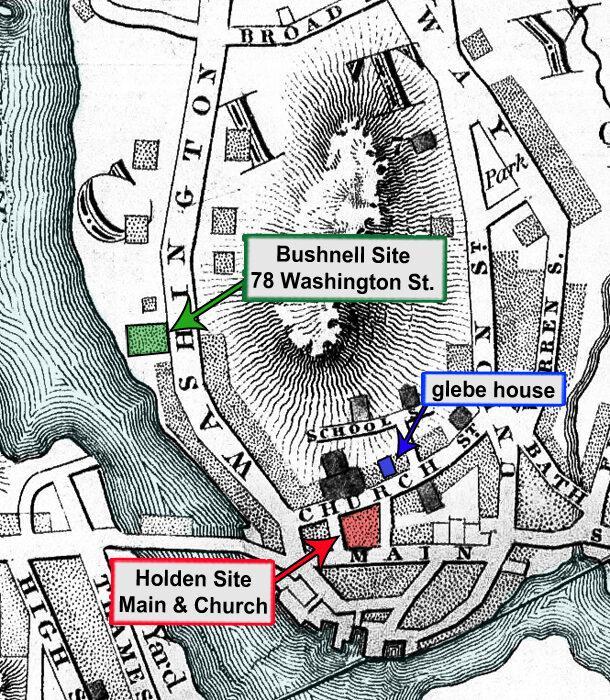
1790: The wooden church building at the Bushnell site was disassembled. It was moved, enlarged, and erected on a site offered by Phineas Holden in the Chelsea district of Norwich. Its new lot spanned between Main and Church Streets.
1790: After the church building was removed to Chelsea, the entire Bushnell site accommodated a cemetery without any obstructing structures.
The map shows the Bushnell site, the Holden site, and the rector’s glebe the term “glebe” refers to a building or land that was historically set aside to support a rector’s income house.
May 19, 1791: Bishop Samuel Seabury II dedicated the recently moved church building on the Holden site in the Chelsea district of Norwich.
1791-1846: Parish held services at the church built on the Holden site. When the society removed to this new edifice, they carried their designation, Christ Church, with them, and the house they left was closed for a short time.
1820s: The congregation, seeing the upcoming town ordinance to forsake wooden structures and build in brick or stone to resist fires, commences the building of a newer, larger church a few rods down Main Street. The structure straddled both Main and Church Streets, with the main entrance facing Church Street.
1829: The old wooden church on the Holden site was sold to the town of Salem, CT, for $500. It was taken down the following year and then reconstructed in Salem in 1831, where it stands to this day, currently the home of their historical society.
Before 1840: The property was sold to the Second Congregational Society, which then built its church on the site in 1844.
1846: During the rectorship of Reverend William F. Morgan, the society decided to build a grander Christ Church on the original Bushnell site. For the past sixty years, the site had been used exclusively as a cemetery. Now, on this ground, which holds the ashes of the deceased, a new church building in an antique architectural style was constructed at a cost of nearly $50,000 (equivalent to $2.1 million in 2025).
The Main Street location was kept in the parish as a chapel until about 1850, when it was sold to another Episcopal Society, which became the Trinity Episcopal Church.
Richard Upjohn (1802-1878): designed this new edifice for Christ Church. He was one of the premier Gothic Revival architects of the mid-nineteenth century, creating many prominent Episcopal churches throughout New England. He was a premier architect of the era, known for designing many significant churches like St. James Church in London.
Bishop Alfred Lee (1807-1887), the Bishop of Delaware, laid the cornerstone on August 31, 1846, and the church was consecrated in 1848.
1848-2021: Christ Church services were held at 78 Washington Street.
Notable People Associated with Christ Church
Reverend John Doolittle Tyler (1742-1823) was a central figure in the church’s early history, serving as its clergyman for 54 years. The Bishop of London ordained him in June 1768, and the following year, he began his service at Norwich.
Reverend Tyler was an interesting preacher. His voice was sweet and solemn, and his eloquence persuasive. The benevolence of his heart was manifested in daily acts of courtesy and charity to those around him.
He studied medicine to benefit people with low incomes and to discover remedies for some of those peculiar diseases to which no standard specifics seemed to apply. His pills, ointments, extracts, and syrups made him a local celebrity. During the latter years of his life, Reverend Tyler was so infirm that he needed assistance in performing his duties.
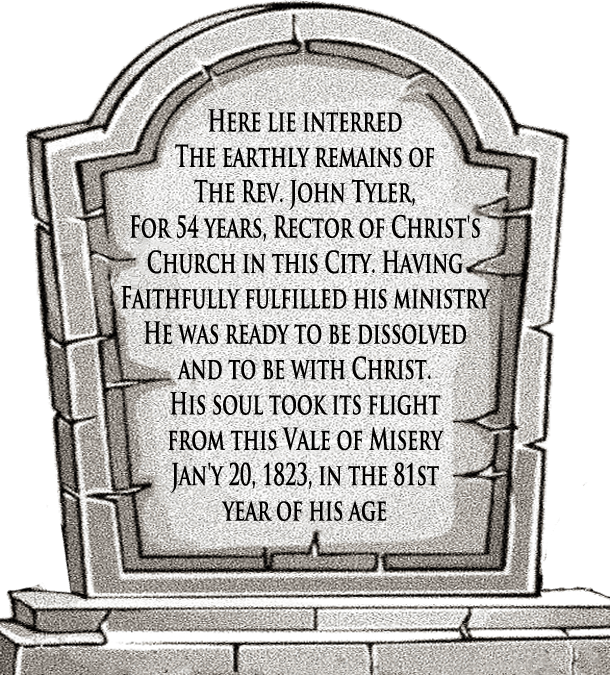
Reverend Tyler died Jan. 20, 1823, in the 81st year of his age. His remains, along with his wife’s, are interred in a crypt beneath the chancel of the current church building at 78 Washington Street.
When the new church was built on the old site, the stones, but not the dead’s relics, were removed. The edifice was erected over the sacred repository.
The graves of the Reverend Tyler and his wife were just under the altar. A mockup of the inscription for Reverend Tyler’s headstone is shown on the right.
Reverend Seth B. Paddock became rector after Rev. Tyler’s death. His son, Benjamin H. Paddock, later served as a rector for the nearby Trinity Church
Bishop Samuel Seabury II (1729-1796) was the first Episcopal bishop in Connecticut and dedicated the post-Revolutionary War Christ Church building in Norwich in May 1791.
Reverend Seth Birdsey Paddock (1795-1851) became rector after Reverend Tyler’s death. His son, Benjamin H. Paddock, later served as a rector for the nearby Trinity Church in the Chelsea district of Norwich.
Gertrude Haile Lanman (1850-1920) was a prominent member of Christ Episcopal Church at the turn of the twentieth century. She was one of the wealthiest women in Connecticut and lived on Washington Street, several blocks north of the church. Following her husband’s death in 1903, Mrs. Lanman donated thousands of dollars to Christ Church. She gave the money to start a fund for a boys’ club in Norwich.
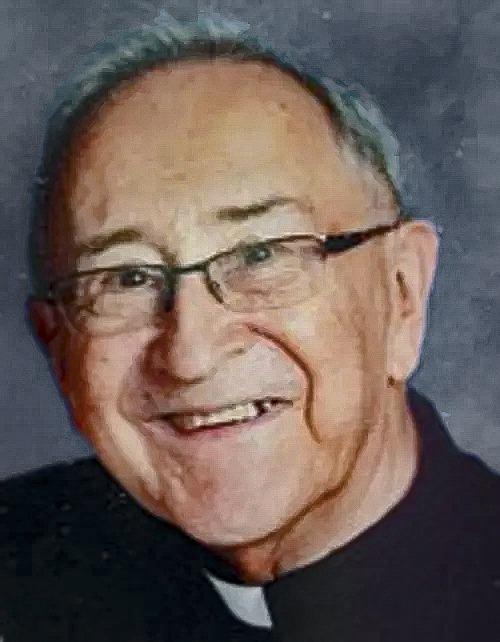
Reverend Donald Robert Lillpopp (1933-2022) served as rector from approximately 1980 to 1998 and is widely remembered by former Christ Church parishioners.
Christ Church Cemetery
Today, many headstones from the Christ Church cemetery are stored in the church’s sub-basement, beneath the church’s main level.
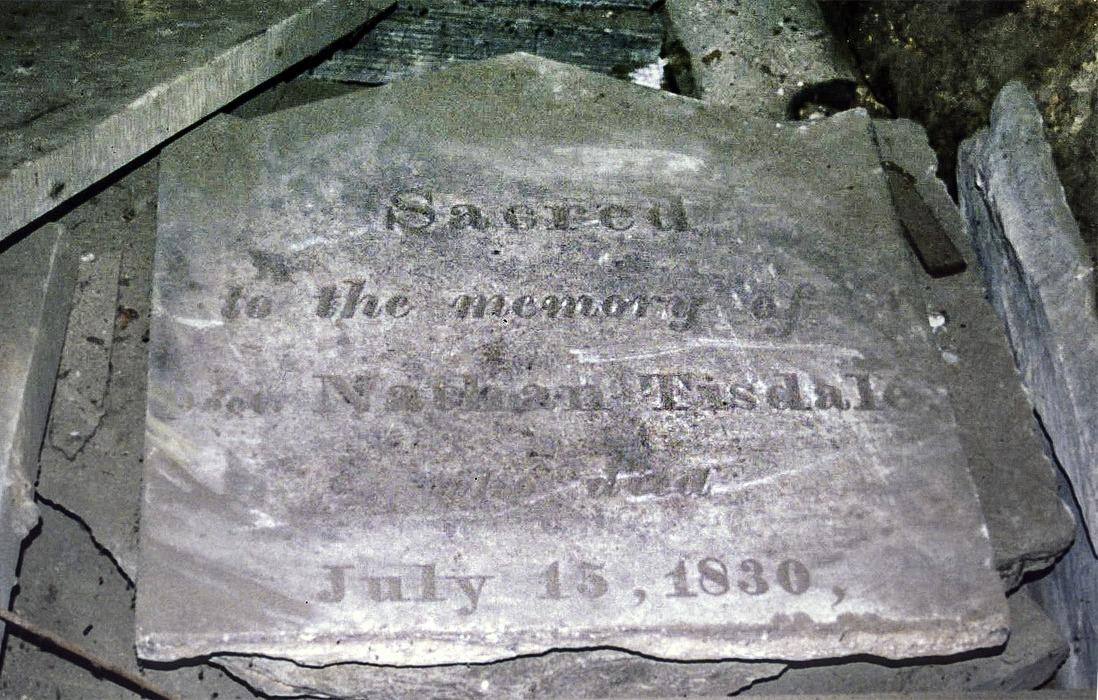
Dr. Nathan Tisdale Headstone *Place cursor over images to magnify
The stone shown here was carved for Dr. Nathan Tisdale (1772-1830) and his wife, Elizabeth Tyler Tisdale. She was the fourth daughter of the beloved rector, Reverend John Tyler.
Nathan Tisdale served in the early U.S. Navy during the Quasi-War and Tripolitan War as a surgeon’s mate, or assistant doctor. He left the Navy in 1804, setting up his medical practice in Bridgeport, CT, before moving back to Norwich.
The upper portion of Dr. Tisdale’s headstone, shown on the left, was photographed in the church’s basement by Jos. N.R. Morneault in 2006.

Dr. Nathan Tisdale Headstone
mockup with words easier to read
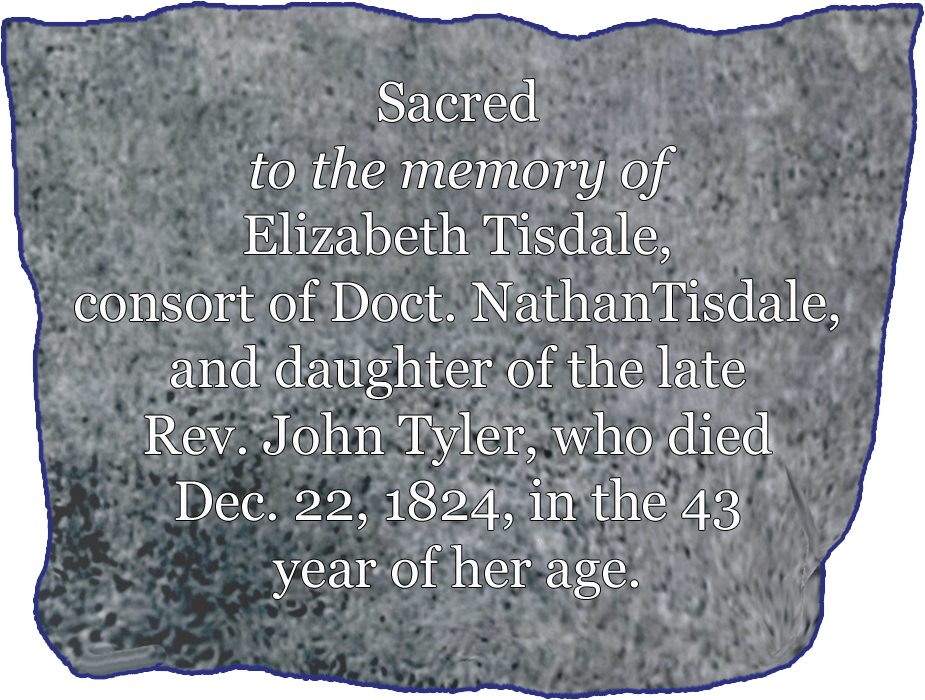
Mockup of Elizabeth Tyler Tisdale’s Headstone
Dr. Nathan Tisdale was highly respected in Norwich. A portion of his obituary, printed in the Norwich Bulletin newspaper, reads:
“As a kind, affectionate, and candid physician, his patients will always remember him with gratitude. He was a warm-hearted friend, and a tender parent, but these ties are not the limit to the loss sustained by his death – the deprivation is felt, not by his family and intimate friends alone, but by a whole community.”
The epitaph for Elizabeth Tisdale, shown on the left, was carved into the lower portion of the couple’s headstone.
The life and times of Dr. Nathan Tisdale, including his achievements and adventures, are recorded in his biography, written by Mr. Jos. N.R. Morneault. (Info Source 2)
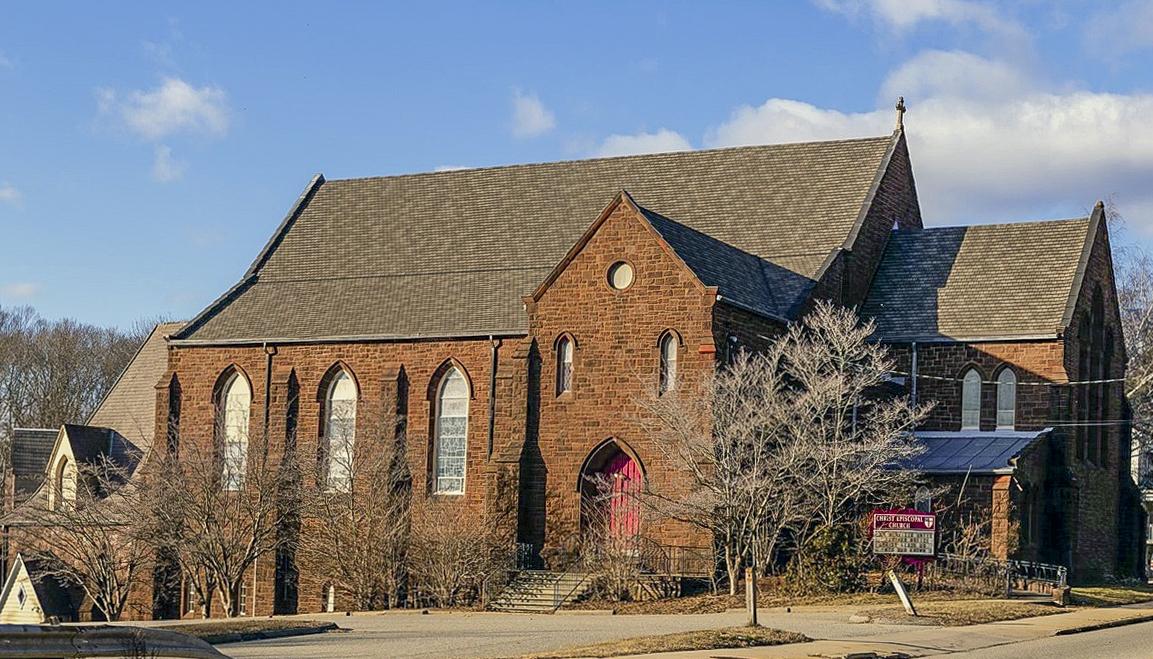
Christ Episcopal Church ~ 78 Washington Street ~ 2025
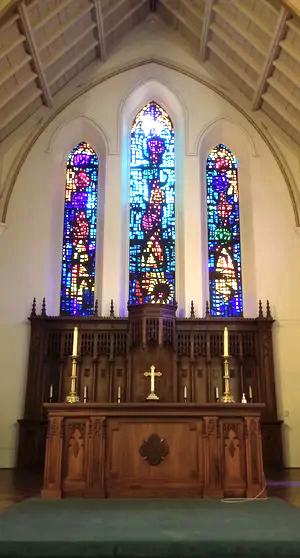
Christ Episcopal Church Altar
Acknowledgements
A sincere thank you to Jos. N.R. Morneault for his numerous contributions to this article
“History of Norwich, Connecticut: From Its Possession From the Indians, to the Year 1866,” pp 451-459, by Frances Manwaring Caulkins
“Dr. Nathan Tisdale – Surgeon’s Mate, US Navy,” 2025, pp 29-23 & 70-75, by Joseph N.R. Morneault
“Died in this City, on the 15th inst., very suddenly, Dr. Nathan Tisdale, aged 58” 07/21/1830, p 3, column 5, Norwich Courier
“History of New London County, Connecticut: With Biographical Sketches of Many of Its Pioneers and Prominent Men,” 1882, p 295, by Duane Hamilton Hurd
“Diverse, Historic, Spiritual: Norwich Centers of Worship Reflect Changing City,” 12/23/2007, by John-Manuel Andriote
“Christ Episcopal Church in Norwich Connecticut,” 04/15/2025, by Tom Kaszuba
“Christ Episcopal Church in Norwich Connecticut,” 2025, by Tom Kaszuba
“Christ Episcopal Church Altar,” 2021, by Rev. Stacey Kohl
“Rev. John Doolittle Tyler,” FindAGrave.com
“Rev. Donald Robert Lillpopp,” Norwich Bulletin
1850-1971: Trinity Episcopal Church ~ Norwich
A group of 39 men agreed to associate and organize the Trinity Church parish on January 7, 1850. The first two paragraphs of their original association document read:
“Whereas by the blessing of Almighty God the Episcopal Church in this city has been so far prospered that His people have been enabled to build two commodious and substantial churches, and now, and for months past, more sittings have been called for than could be furnished in the new and larger edifice on Washington Street. And inasmuch as the time seems to have come when the interests of the Church would be still more prospered by the organization of a new and independent parish to occupy the old church edifice;
“And whereas, the parish of Christ Church have agreed to sell the said old church organ and all other fixtures etc., appertaining thereto for the sum of five thousand dollars.”
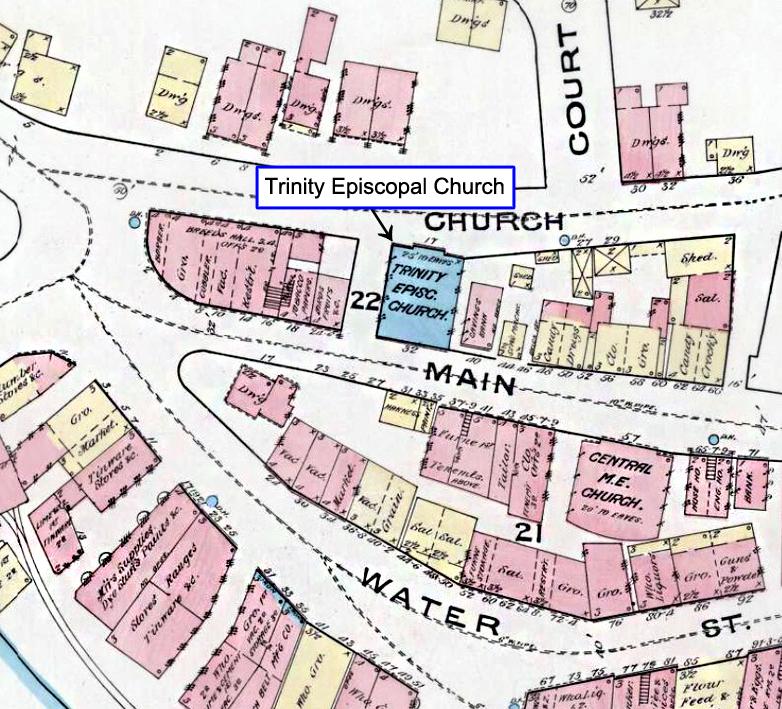
1885 Map of Norwich Main Street
*Place cursor over image to magnify
The Trinity Episcopal Church, building identified in the 1885 map shown here, was initially dedicated in 1829 as the Christ Church of Norwich. It stood on a lot extending from Main to Church Street, and the total cost, including the organ and furniture, was approximately $13,000 ($334,000 in 2025 $). That church was consecrated by the diocesan Bishop, Reverend Thomas C. Brownell, on July 29, 1829.
However, in 1846, the Christ Church Society decided to relocate its church services to 78 Washington Street. They had used that place (the old Bushnell site) sixty years prior as a meeting place and as a cemetery.
A new, antique-style edifice was built atop the cemetery at a cost of nearly $50,000. A separate tower from the church was part of the original plan, but it was never constructed. Bishop Lee of Delaware laid the cornerstone on August 31, 1846, and Christ Church was consecrated in 1848.
The building that the Christ Church Society left behind, shown here, was relinquished to the Trinity Church in 1850. The denominations using the building changed from Christ Church to Trinity Church.
Former rectors for the Trinity Episcopal Church include:
Rev. Edward O. Flagg was called as the first rector of the Trinity church. He served from April 10, 1850, to June 1853.
Rev. Benjamin H. Paddock, (a native of the town and son of a former rector of Christ Church,) from August 1853 to 1860.
Rev. John V. Lewis, from 1860 to August 1865, when he accepted a call to Washington, D.C.
The 1914 Sanborn Fire Insurance Map shows the church still standing.
From 1865 through 1882 four additional men served as rectors of the Trinity Church. They are listed in Info Source XX
Rev. J. Edred Brown, rector of the Trinity Episcopal Church, led a Christmas service on December 28, 1910. (Norwich Bulletin)
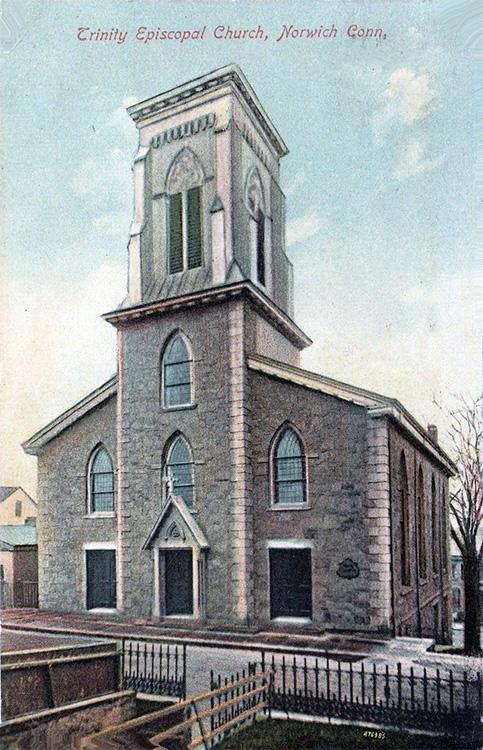
Trinity Episcopal Church ~ c1905
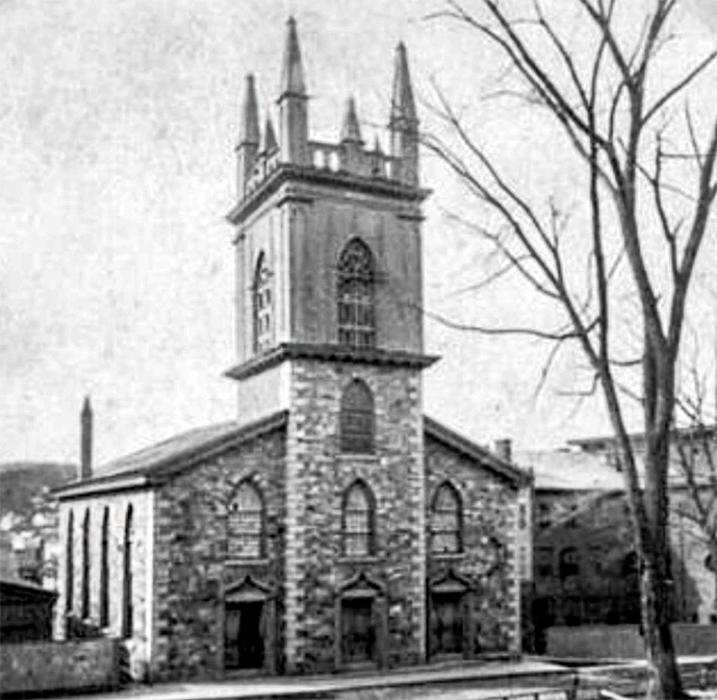
Trinity Episcopal Church
*Place cursor over image to magnify
The architectural plans for
Trinity Episcopal Church
*Click on the two right-pointing arrows to view in full screen
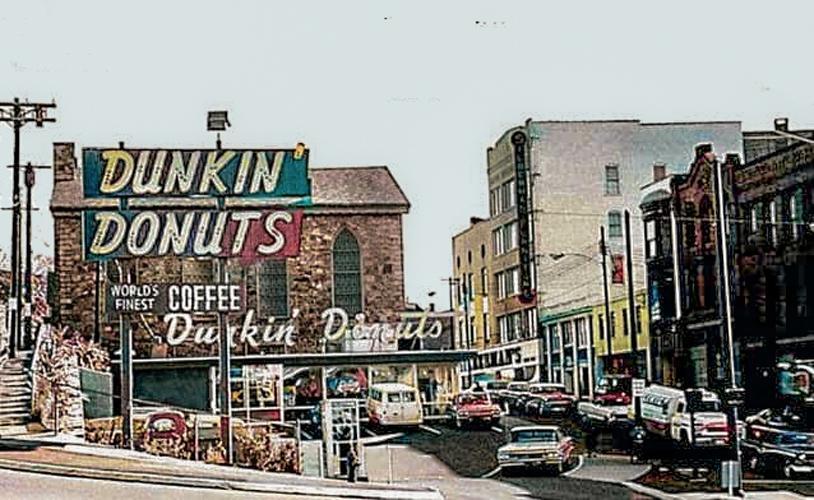
Trinity Episcopal Church Behind Dunkin’ Donuts ~ 1960s
The photo, shown on the left, taken in the 1960s, shows the Trinity Episcopal Church building behind Dunkin’ Donuts.
This building, which housed the former Christ Church, Trinity Episcopal Church, and later The Thorn coffee house, burned on March 1, 1978.
*Place cursor over image to magnify
Acknowledgements
“History of Norwich, Connecticut: From Its Possession From the Indians, to the Year 1866,” p 457, by Frances Manwaring Caulkins
“History of New London County, Connecticut: With Biographical Sketches of Many of Its Pioneers and Prominent Men (1882),” pp 296-297, by Duane Hamilton Hurd
“A Modern History of New London County, Connecticut,” Vol. 1, 1922, p 311, by Benjamin Tinkham Marshall
“A half-century of Parish Life: Historical Sermon,” 1900, by Reverend J. Eldred Brown
“Trinity Episcopal Church, Norwich, Ct.,” Public Domain postcard
“Trinity Episcopal Church,” Facebook Norwich CT USA Pictures
“1885 Sanborn Fire Insurance Map of Norwich,” annotated by IconicNorwich.org
“Architectural Plans of the Trinity Episcopal Church, Norwich, CT.,” courtesy of WikiMedia