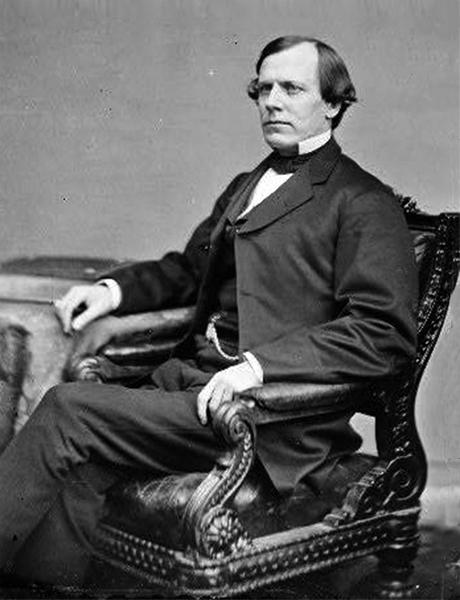
Henry H. Starkweather was born in Preston on April 29, 1826. From early boyhood, he was impressed with the conviction that if he accomplished anything commendable in life, it must be the fruit of his personal endeavor. Although his early years were devoted to labor on his father’s farm in his native town, he employed his leisure hours in reading, in the observation of men, and in the study of the causes that lie at the foundation of the triumphs and defeats by which the history of the world is marked. He thus laid down at the beginning of life the great law which guided him to its close.
At the age of twenty-two, Henry went to Norwich and entered the law office of the Honorable Lafayette S. Foster, under whose guidance and tutelage he studied until he was admitted to practice in 1850. Shortly after his admission to the bar, he formed a partnership with the Hon. Edmund Perkins of Norwich, then a leading lawyer in Eastern Connecticut, with whom he was associated for several years. He was an assiduous worker and soon acquired an enviable position among his professional associates, among whom were numbered some of the ablest and most distinguished in the state.
He labored in his profession for little more than a decade when his tastes and inclinations led him into political life. He was appointed Postmaster at Norwich in 1861 and thereafter gave but little, if any, attention to his profession. In politics, he was originally a Whig, but was active in the formation of the Republican Party, through which organization he was elected a member of the lower house of the state legislature in 1856.
He was a delegate to the 1860 Republican National Convention, which nominated Abraham Lincoln as the U.S. presidential candidate. Similarly, in 1868, he was a delegate to the convention that nominated General Ulysses S. Grant.
As a private citizen, as a member of a Christian church, as a lawyer, as a politician, as a representative in Congress for a longer period than any of his predecessors, he was respected, honored, and successful. He entered Congress in 1867 without the prestige of a great name. His approach was heralded by no marked achievements, by no appendage that would lift him up to high eminence at the outset. In the absence of these, accompanied by an unpretending, unobtrusive demeanor, it would not have been deemed strange had he ranked among the least distinguished of the representatives of the nation. But he had influence from the beginning, and his influence had rapid and consistent growth, till it culminated in placing him among the wisest, the safest, the ablest members of the body to which he belonged at the time of his death. It has been said of him, and we believe justly, that none among the Republican members of the House had won more or better friends, and, with a single exception, had gained greater influence or a more thorough understanding of the principles which lie at the foundation of our national prosperity. There were none among them whose wisdom was more sought in emergencies, none whose judgment was more respected, none whose keen penetration and foresight did better service in seasonably detecting threatened evils, and in devising the best means for the general good.
Mr. Starkweather was remarkable for the power of intuition. What the mass of men learn by protracted examination and study, by reasoning and deduction, he comprehended at a glance, a power that contributed greatly to his influence and success. He was distinguished for strong common sense. He did things at the right time and in the right place. He never violated the laws of propriety in his business transactions or in any of the relations of life. He knew well how to avoid, in language and practice, whatever would subject him to the envy or censure of his associates, or awaken aversion anywhere. He had a kind regard for the feelings and interests of others, and a way of showing it that commended him readily to the confidence of all. He had a classic face, full of tenderness and power, which well expressed the features of his mind. The law of kindness was written all over it, and on all his movements, so prominently that none feared betrayal in unbosoming to him their burdens or seeking his counsel. Another marked trait of his character was inflexible honesty. In his counsels, in his measures, in his life, everywhere, its principles governed him.
Henry Starkweather never sacrificed principles to secure personal gain, or to please, or to carry out any purpose, however seemingly important. He was a philanthropist and patriot in the best sense, and above all, a Christian gentleman, without affectation of sanctity; without any ostentatious observance of the ritual of Christianity, entirely exempt from all taint of sectarian bigotry, he was a cordial believer in the principles of the Christian religion. A religion of kindness, of integrity, and of benevolence in its largest breadth was his religion. The virtues of which humanity is capable had in him evidently more than ordinarily consistent and vigorous development.
The remembrance of them is fragrant. It is pleasant to call to mind an example of such excellence, when many are proving faithless to their trusts, and utterances of the degeneracy of the race are being heard from so many tongues. It is pleasant to trace in such a life so much that is ennobling and pure, now left as a legacy to his family, to the church, and to the nation. We rise to a higher appreciation of man’s dignity and glory in the contemplation of these virtues. But we mourn that his light went out in the pride of his manhood, “before even the frosts of age had silvered his locks, or the hand of Time furrowed his brow,” and we shall ever retain the remembrance of his person and character with mingled feelings of reverence and love.
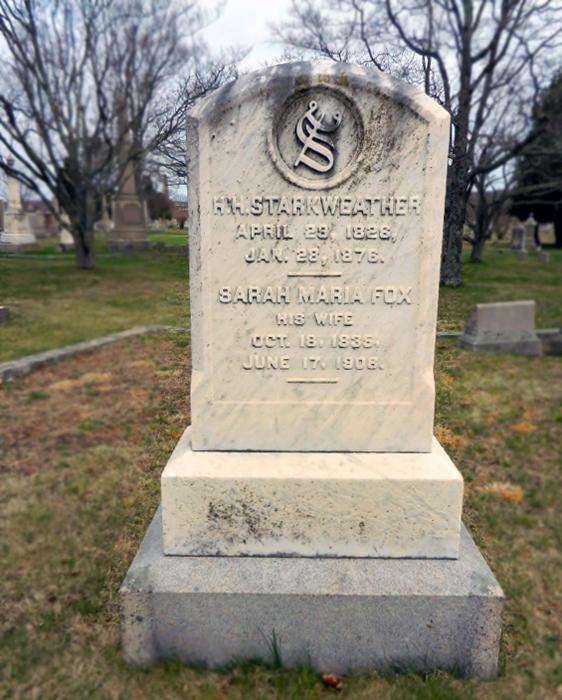
He died while serving in office as a member of the United States Congress on January 28, 1876. He was married to Sarah Maria Fox Starkweather. They had three children, Henry, Lydia, and Elizabeth.
Reference
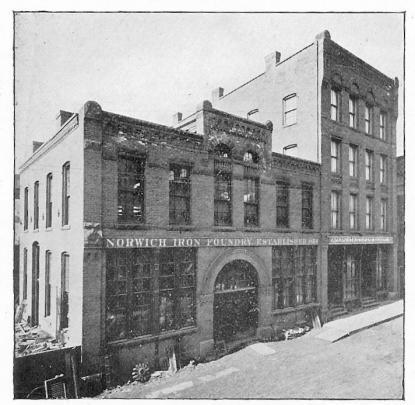
Norwich Iron Foundry
Alfred H. Vaughn founded the Norwich Iron Foundry in 1854. Both light and heavy iron goods were made and sold by the enterprising proprietors of this extensive industry. This establishment fronted on 11-25 Ferry Street, adjacent to the back of today’s Otis Library.
In 1881, Messrs. A. H. and C. W. Vaughn formed a partnership and established the business. The foundry was materially enlarged in 1884 into a four-story brick structure with a 35-foot frontage on Ferry Street, which was used to store patterns.
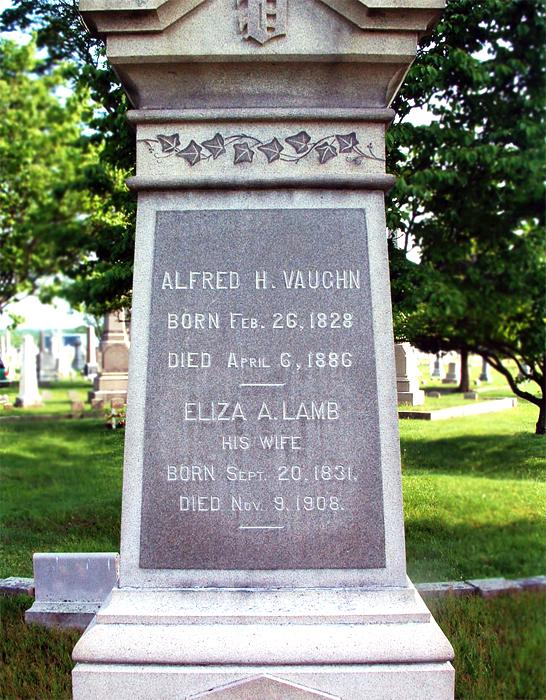
After Alfred’s death in 1886, the business continued under the same name.
In 1887, a new two-story brick building was erected and adjoined to the 1854 building. In the latter building, along with others in the rear, is the foundry proper, where powerful cranes, a large cupola, and other necessary implements are located.
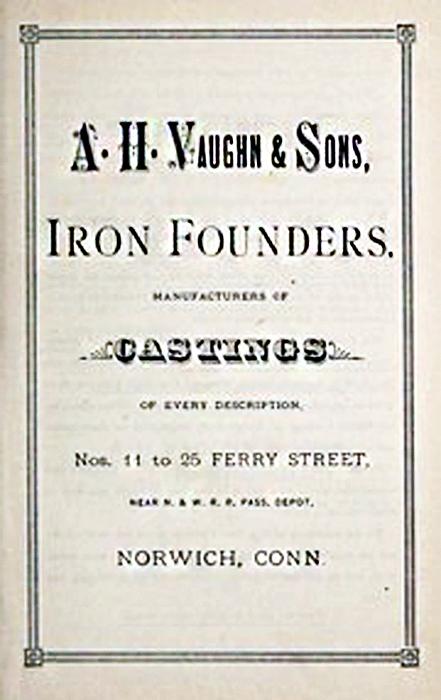
Among the various products of this busy foundry are architectural ironwork and modern stable fixtures. In addition to general foundry work, the firm executes contracts for castings used by local steam-heater industries and other ironworks in the vicinity. Railroad and mill castings also form parts of the work. Water pipes, lamp posts, cistern covers, cattle mangers, round and square grates, grate bars, gratings, park settees, lawn and cemetery vases, stair plates, ash pit doors, window frames, balances, hand truck and car wheels, gearings, pulleys, l hangers, couplings and boxes are also enumerated in the work emanating from this foundry. A great variety of the smaller articles is kept in stock at the capacious warerooms.
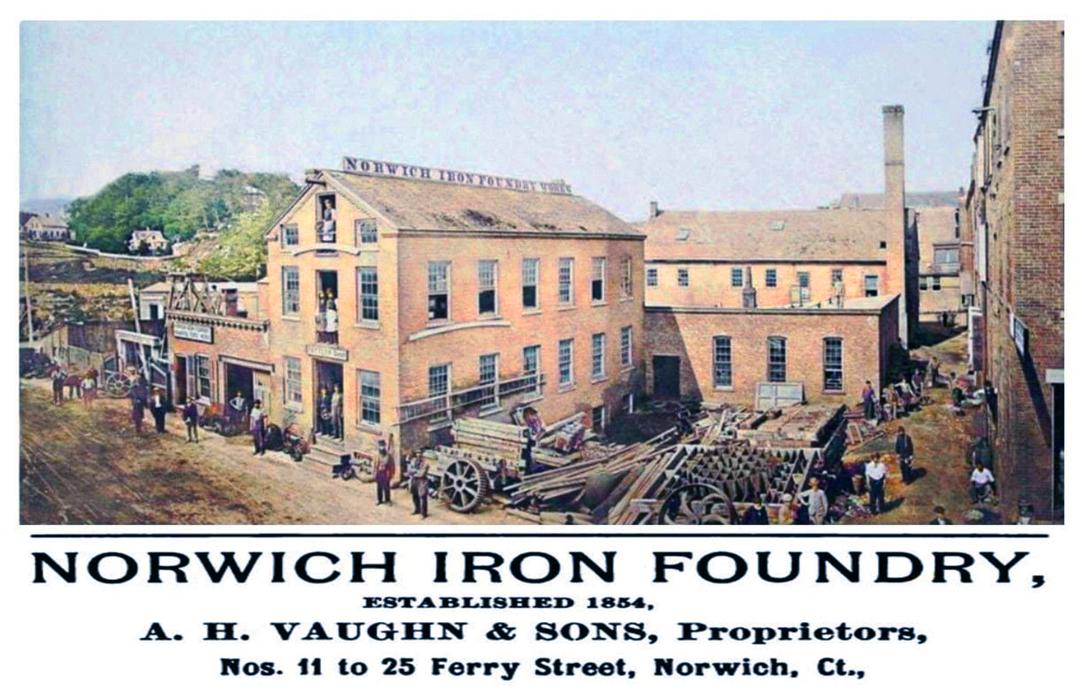
A.H. Vaughn & Sons possessed the most extensive stock of patterns in Connecticut. In addition to the vast accumulation of patterns from the firm’s forty-year business, it purchased the entire stock of patterns belonging to the Shetucket Foundry Company, which had a large business during its existence. The Vaughn foundry employed 50 men, and the capacity of the foundry is 1200 tons.
The Norwich Iron Foundry on Ferry Street and Alfred H. Vaughn’s gravesite in Yantic Cemetery.
*Place cursor over photos to magnify
Reference