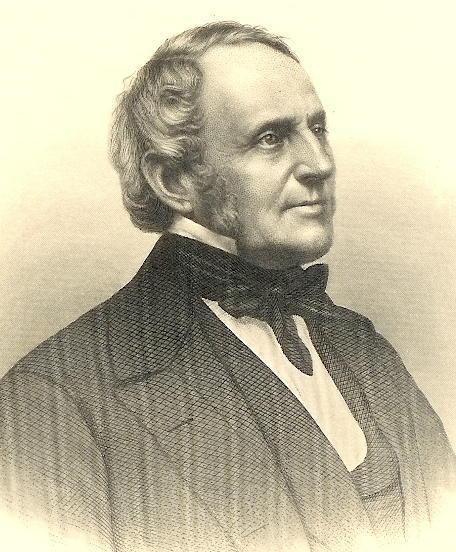
William Williams Jr. was born in Stonington, CT, in March 1788, the son of William Williams, a self-made man of exceptional business acumen and integrity. Like his father, William, Jr. possessed a great interest in the mercantile area. He was educated in district schools in Stonington and graduated from Plainfield Academy. Following graduation, William traveled to New York City, where he worked as a clerk in the commission-house of W. & S. Robinson, where he stayed for about three years, acquiring practical knowledge in the duties of a shipping merchant’s business. In 1806, William returned to Stonington, where he was dispatched on one of his father’s ships bound for Labrador and Bordeaux.
This, his first voyage, took two years. Upon his return, William went to Norwich and, in partnership with his father, initially engaged in a large-scale flour manufacturing business, followed by cotton, until he closed the businesses in 1818-19. William returned to the mercantile business and, from 1821 to 1827, made successful voyages to Europe and South America. In 1828, he became involved in the whaling business alongside Capt. Acors Barns and formed the highly successful firm of Williams & Barns. He remained in this business for the remainder of his life. The success of William’s business contributed significantly to New London’s reputation as a center for the whaling industry.
References
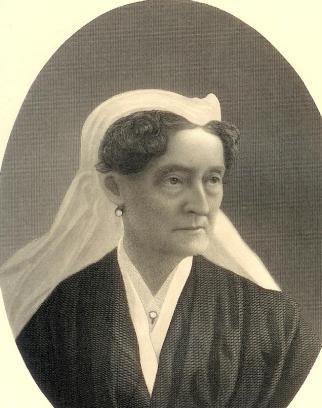
Harriet Peck was born in Norwichtown in March 1795 and married Gen. William Williams in May 1812. She was the daughter of Capt. Bela Peck, some of whose high qualities of character she reproduced in her own life, and whose memory she loved to honor. In 1813, the Williamses purchased the Teel House off Chelsea Parade in Norwich, where they made their home for over fifty years. Harriet was remembered for her abundance of social grace and open-hearted charity. At the time, her husband was among the founders of the Norwich Free Academy.
She, on her own, instituted many scholarships and prizes and founded the NFA library, which she named in honor of her father, “The Bela Peck Library.”
The death of her husband, William, left her the last surviving member of this well-known Norwich family, all three of her children having predeceased her husband. It was during her widowhood that the construction of Park Church took place, and Harriet made significant contributions to that project. She donated the building lot for the church opposite her estate, as well as the tower clock and chime of ten bells, and the west stained glass window of the sanctuary. Harriet gave these gifts in the declining years of her life.
A historical note states: Soon after the tower clock was put in place, a series of phrases were proposed to characterize it, among them: “Why is it like its giver? Because it is full of good works”. When Harriet heard of this, she remarked that a better answer would be, “Because it bears the marks of time on its face.”
Her friends will recognize the quick wit of the answer as characteristic of the dear old lady. But generous as she was in public donations, Harriet excelled in private offerings as well. In her last will, she bequeathed a significant portion of her fortune toward the foundation of a high school for girls in New London to be dedicated in memory of her oldest son, Thomas W. Williams, who at the time of his death lived there.
Harriet died in October 1880 at the age of eighty-five.
References
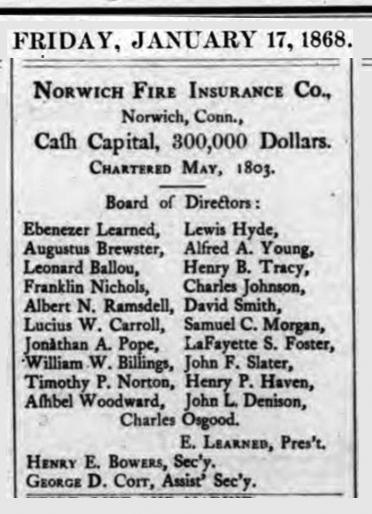
Ebenezer Learned (1811-1887) founded the Norwich Fire Insurance Company in 1846. The company was taken over by his son, Bela Peck Learned, in 1870 and renamed B. P. Learned & Co. In 1865, the Norwich Board of Trade listed Ebenezer’s annual income to be $13,181. Ebenezer Learned died in July 1887, and Bela continued in the business until his death in March 1910. At that time, his son, Ebenezer (b. 1876, d. 1948), grandson of the founder, took control of the company and continued it under the same name.
The Learned family was prominent in the real estate and insurance industries for many years, having established the first stock fire insurance company in Connecticut. The company was chartered in Norwich in 1803 and was capitalized for $100,000 with provisions to extend to $300,000, which it did in 1864 as the company expanded its territory. In these early days, no provision was made to hold reserves against liability. So, a dollar, when it reached the treasury, was considered earned. Today’s earnings are calculated when the policy reaches term. In 1849, premiums totaled $22,056, and interest amounted to $1,204. Losses and stock dividends amounted to $22,270.38.
In 1854, Ebenezer Learned was the secretary of The Norwich Fire Insurance Company and became its president in 1864. The Great Chicago Fire in 1871 caused such extensive losses that the company, then the oldest stock insurance company in Connecticut, was compelled to cease operations.
References
Ebenezer and his wife, Matilda Denison, had a son, Bela Peck Learned, in 1837. Sadly, Matilda died 12 days after Bela’s birth.