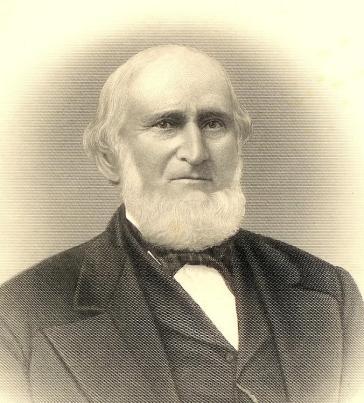
George W. Geer was born in Norwich in March 1806. He was one of ten children (seven boys and three girls) of Wheeler Geer, a ship builder and sea captain, and Sally Roath Geer. Five of his brothers became masters of sailing vessels, and later, four became masters of steamships. One sister died young, and the two remaining sisters married ship captains. At age eighteen, George was master of a sailing vessel plying in the coastal trade. Later on, George Geer was either the master or pilot of several boats and supervised the construction of, and was part-owner of, several ships.
In 1844, the steamer “Shetucket” was built under his supervision, and when completed, he took command of it. During the first six months of sea trials, George noticed that the “Ericsson” propeller, commonly used at the time, was inadequate and had it replaced with an “R.F. Loper” propeller. This proved insufficient for the steamship as well. Using his knowledge of marine engineering and natural inventiveness, Capt. Geer developed a screw type propeller based on a new principle. When built and installed on the “Shetucket,” the travel time to New York City was cut by one-third, with a corresponding reduction in fuel consumption. Soon, all steamships in the area and later around the world were being driven by Capt Geer’s invention.
The president and officers of the Ericsson Company, makers of ship propellers, approached Capt. Geer requested permission to begin producing his newly designed ship’s propeller. Capt. Greer graciously gave his consent and would accept no compensation in return. As a result of this business agreement, the Ericsson Company experienced growth and prosperity. Capt. Geer, unfortunately, neglected to apply for a patent on his invention for some time, and when he finally did, another inventor challenged his right to patent. A lengthy investigation was launched to determine who rightfully owned the patent for inventing the screw type propeller. Time passes, and in the middle of the legal process, the attorney in charge of Capt. Geer’s application suddenly died, and all papers related to the case were lost or misplaced. By this time, screw type propellers had come into general use and were considered common property, and George discontinued any further pursuit of his application.
In 1852, Capt. Geer joined with a group of investors in purchasing the steamship line formerly owned by the Norwich & Worcester Railroad Company. During the next twelve years, he would occasionally pilot or command one of their steamships. He supervised the building of the steamship “Charles Osgood” and sold his share in the business to Mr. Osgood sometime later. In 1855, Capt. Geer built the tugboat “George W. Geer,” which worked in the New York Harbor for many years. Around 1861, Capt. Geer was appointed inspector, weigher, and gauger for the Port of Norwich, a position he held for many years.
References