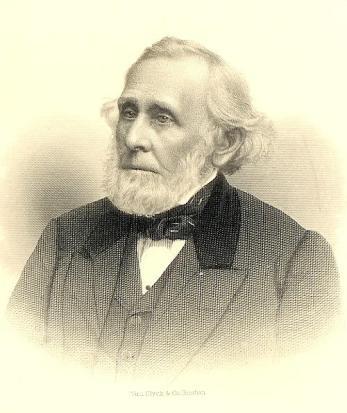
Leonard Ballou, the first cotton manufacturer in Killingly, CT, was born February 23, 1794, in Cumberland, RI. The eldest son of Noah Ballou, a shipbuilder and farmer, Leonard initially attended a local school, then later a private school, all the while working in his father’s shipyard and on the farm. It was through this work that Leonard Ballou discovered his interest in mechanical processes and a natural facility in the use of tools. In his mid-20s, Leonard continued to develop his engineering skills while working on several mill construction projects in Rhode Island. Word of his exceptional engineering skills soon spread. He was selected by Watson, Tingley & Rathbone of Providence to construct their new mills and waterwheels in Willimantic, CT. He later completed projects for Wilkinson’s, Slater’s, and Brown’s, all leading manufacturers in Rhode Island at that time.
Leonard soon realized that his financial success would require him to go into business for himself. In 1825, as a result of his hard work, he had accumulated a small sum of money. In November of that year, along with his father-in-law, Jabez Amsbury, he purchased a mill privilege on the Five-Mile River in Killingly, CT, which eventually became Ballouville.
The property contained a small gristmill used in grinding rye for the production of gin. Leonard, with his engineering background and skills, recognized that the mill would require numerous improvements before it could become a profitable cotton mill. With the additional help of his two brothers-in-law, George Weatherhead and Mowery Amsbury, improvements were made to the waterpower efficiency, and the mill was expanded to three stories, measuring 50 feet by 32 feet. In the fall of 1826, the mill began operations with 10 looms. Funding for the initial capitalization from all four parties amounted to $6,000.
Ballou soon realized the mill was too small to turn a profit. He sought help from a Providence merchant, and due to his reputation for hard work, honesty, and business skills, he was able to borrow the necessary funding to expand the mill. Business increased, and in 1834, the capacity of his mill more than doubled. In 1836, Ballou bought out his partners, who he had helped set up their mills on the same river, and became the sole owner. As the years passed, he continued to expand his mill and introduced new equipment to increase profits and lower production costs.
In 1845, after twenty years in Killingly, Leonard moved his family to Norwich. Two of his homes can still be seen on Washington Street (171 and 183). Ballou had entertained the idea of retiring when he reached the age of three score and ten. In February 1864, he sold his property along Five Mile River to his Norwich neighbors, Lorenzo Blackstone and Henry Norton, who ran the mills as part of the Attawaugan Manufacturing Company. In 1865, Leonard’s income as reported by the Norwich Board of Trade was $12,042 ($278k in today’s dollars)
In his later years, Ballou was director of the First National Bank of Norwich, trustee of the Norwich Savings Society, President of the Norwich Water Power Co., the Occum Water Power Co., director of the Norwich Bleaching, Dyeing & Printing Co., and Director of the Norwich City Gas Co. Leonard Ballou was an active Congregationalist. A member of Second Congregational Church, he was an advocate and one of the most significant contributors to the construction of Park Congregational Church (1873).
During his lifetime, Leonard was married twice: first to Ann Amsbury in 1822, and then, after she died in 1852, to Dolly Kingsley in 1854, who died in 1862. He was survived by two daughters, Lydia, who married John B. Young of Tiffany & Young now Tiffany’s in NYC, and Amelia, wife of Albert H. Almy of Norwich, and a grandson, Leonard Ballou Almy, who became a physician in Norwich.
The unusual success of Leonard Ballou in manufacturing cotton goods, despite many failures, was due to his mechanical education and superior intelligence in the manufacturing process, which enabled him to adopt or reject the various new theories or systems presented daily during nearly half a century of business life. His unimpeachable integrity, promptness in meeting his financial obligations, and never having to sue or be sued by any other person all contributed to his honor and respectability within the community. His name was a synonym for honesty and fair dealing.
He died at his home on Washington Street, August 5, 1880, in the eighty-seventh year of his age.
References
Lucius Carroll was born in Thompson, Connecticut, in January 1815. He left home in 1830 and found work in a retail store in Webster, MA. Following several years of hard work, Mr. Carroll came to Norwich and opened a retail store in 1843, dealing in mill and manufacturers’ supplies. In 1865, he formed a partnership with E. P. Jacobs and Loren A. Gallop, known as L.W. Carroll & Co. Mr. Jacobs passed away in 1874, and following the retirement of Captain Gallup in 1876, Lucius Carroll took his older son, Adams P. Carroll, into the firm and renamed the business L. W. Carroll & Son.
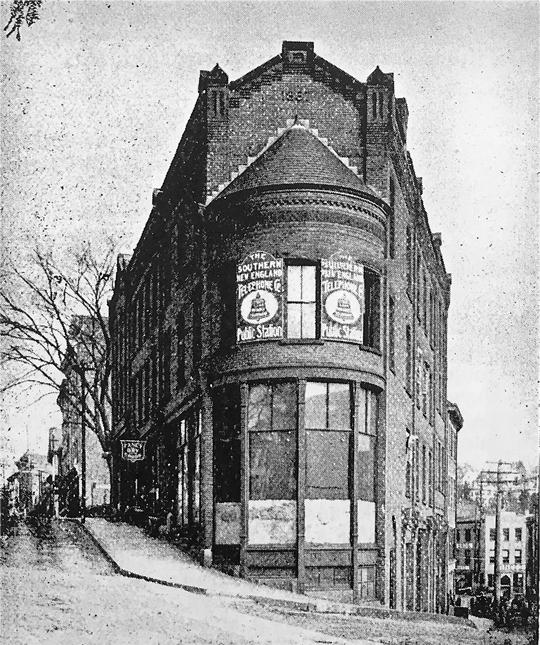
The building referred to as Carroll’s Block was located in Norwich at the corner of Main and Water Street. It is now known as the Flatiron Building. Mr. Carroll was a major partner in the Griswold Cotton Company. He joined forces with Moses Pierce and other promoters of water power, securing rights along the Shetucket River, which led to the formation of the Occum Company, for which Mr. Carroll served as secretary and treasurer. He had a considerable banking interest and was president of the Quinebaug Bank, which later became the First National Bank of Norwich, a position he held from 1856 to 1866. Lucius was a member of the Central Baptist Church.
An engraving of the Flatiron Building, built in 1887, is shown on the left.
He served a term on the Norwich Common Council. He was one of the incorporators of the Norwich Free Academy. In 1900, Lucius retired from the business he had founded fifty-seven years earlier and relinquished control to his son, Adams P. Carroll. Although he lived to be 86, he maintained a sharp memory and was unusually active. Lewis Carroll was an old-school New England gentleman, dignified in his bearing, courteous in manner, and a man who commanded respect at all times.
Lucius Carroll married Charlotte Lathe Pope in May 1843 in Middlebury, MA. They were the parents of five children: Charlotte L. Augusta, died at 16; Charles Lucius, lost at sea in 1864 at 17; Adams Pope; and William Crosby who died in infancy.
George Wyman born May 1859, following public education he entered the family business (L. W. Carroll & Son) were he worked for several years. In 1902, he withdrew from the company to join the bond, stock, and real estate business in Norwich. George married Emma Frances Briggs, daughter of Ira G. and Lydia (Andrews) Briggs, her father a wealthy textile manufacturer in Voluntown. They had one son, George Wyman Jr., in 1886.
References
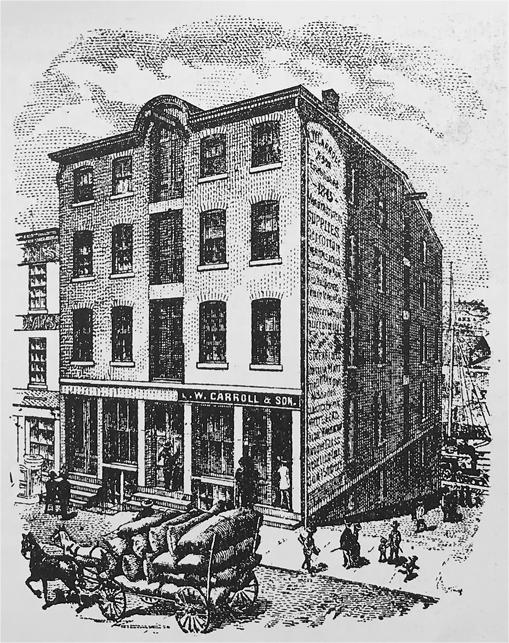
Adams Carroll was born in Norwich in June 1850, the third child of Lucius and Charlotte (Pope) Carroll. He attended local public schools and, after graduating from Norwich Free Academy as valedictorian in 1868, entered Brown University, where he obtained an advanced degree in business, following the death of E.P. Jacobs and the retirement of Capt. In 1876, Adams was taken into the company, which became L. W. Carroll & Son, dealing in mill and manufacturers’ supplies, at 17–21 Water Street, Norwich, CT. For nearly a quarter of a century, father and son continued a prosperous business.
An engraving of the L.W. Carroll & Son warehouse is shown on the left.
Adams was an active member of the Central Baptist Church, serving as trustee and president of the board. He was also a trustee of the Norwich Savings Society and the Otis Library. He was a prominent member of the Norwich Board of Trade, which evolved into the Chamber of Commerce.
Reference