Chester Hillard was born on November 24, 1815, in Preston, CT. In January 1840, he was a passenger on the ill-fated steamship Lexington. He became the sole surviving passenger of the Lexington’s shipwreck. By trade, at the young age of 24, he was a ship’s captain, like both his father and uncle before him.
The story begins on the late afternoon of January 13, 1840. A winter storm had brought bitter cold and high winds to Long Island Sound, and while other steamships remained tied to their docks, the speedy Lexington, built to withstand stormy seas, was chosen to make a run. The ship had gained a reputation for safely completing the overnight journey on schedule.
*place cursor over image to magnify
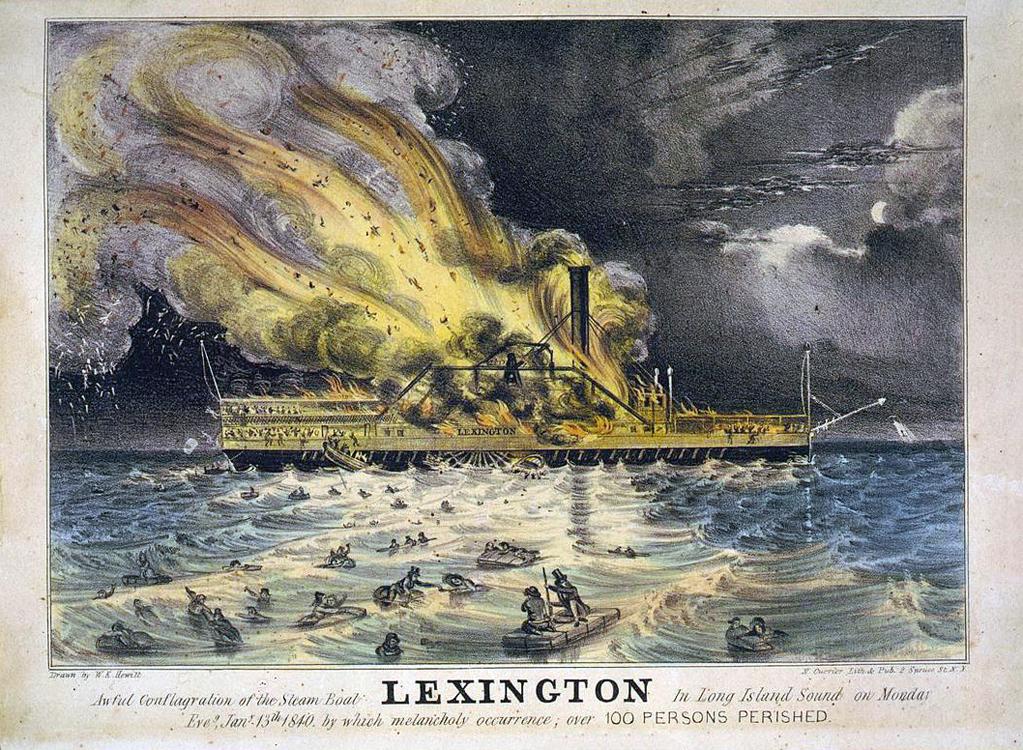
The colored lithograph of the Lexington disaster, pictured above, was produced and widely distributed. It was drawn by William Keesey Hewitt and subsequently published and lithographed by Nathaniel Currier. The popularity of this print launched the company, Currier & Ives, into the national spotlight, becoming the successful business whose prints we still recognize today.
Cornelius Vanderbilt commissioned the Lexington in 1835. Sparing no expense, the wooden ship measured 207 feet and weighed 488 tons. In its time, it was the fastest and most luxurious side-wheel steamer on the New York-to-Boston route. But railroads soon began to compete with the steamship lines for passengers, and in 1838 Vanderbilt sold the Lexington to the New Jersey Navigation and Transportation Company. The Lexington’s wood-burning boilers were replaced with new coal-fired boilers, and the ship was soon returned to service in the waters of Long Island.
The steamship Lexington left its Manhattan East River pier at 4:00 pm, carrying 143 passengers and a cargo of 150 bales of cotton on its overnight run to Stonington, CT. By 7:30 PM, the Lexington was four miles off the north shore of Long Island near Eaton’s Neck lighthouse when the ship’s first mate noticed fire erupting from the cotton bales near the smokestack. Crew members formed a bucket brigade and used a small fire pump to fight the fire, but the strong winds fanned the flames, which quickly spread through the ship.
An evening marked by panic and terror began to unfold. Drive ropes that controlled the rudder burned through, leaving the Pilot, Stephen Manchester, unable to steer the ship. Heat and smoke drove the crew from the engine room. Unable to shut down the boilers, awash in flames, the Lexington plowed on, out of control into the freezing night.
The ship’s Captain, George Child, ordered people into the lifeboats. But with the engines still running, the first boat was pulled into the turning paddlewheel, instantly killing all on board, including Captain Child, who had slipped and fallen into the water. The remaining two lifeboats were launched but immediately capsized in the Lexington’s wake and sank into the freezing waters.
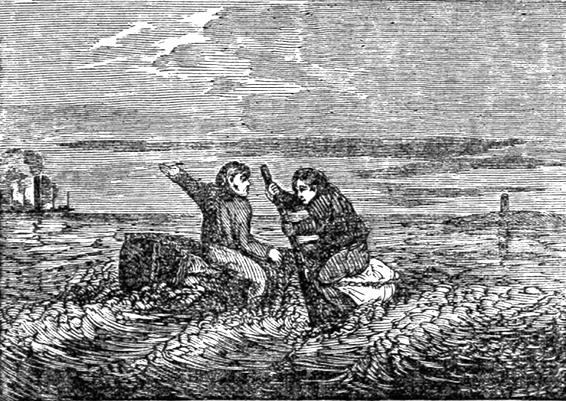
Chester Hillard, who responded to the first alarm, came on deck. He organized the crew and helped them throw cotton bales and anything that would float to the people in the water. With the boilers now spent, the Lexington slowed and began to drift. By 8 PM, the main deck began to collapse in flames, and Hillard, along with one of the ship’s firemen, Benjamin Cox, jumped overboard, clinging to one of the last cotton bales.
Hillard later testified at the coroner’s inquest that, “We were sitting astride the bale with our feet in the water. It was so cold as to make it necessary for me to exert myself to keep warm, which I did by whipping my hands and arms around my body.”
The Lexington continued to drift with the wind and tide until about 3 AM when it sank northwest of Port Jefferson, taking all those who remained onboard with her to the bottom of Long Island Sound.
Hillard reported that he and Cox continued to cling to the floating cotton bale through the night. When Benjamin began to slip in and out of consciousness, Hillard tried to warm him by rubbing and pounding his body. About 4 AM, a large wave capsized the bale; both men managed to scramble back on top, but Cox, weak with hypothermia, soon slipped into the icy water and was seen no more. Captain Hillard clung to the 3′ x 4′ bale until 11 AM the next morning, when he managed to attract the attention of the sloop Merchant by waving his hat and was rescued.
Of all the crew and passengers aboard the Lexington, only four people survived:
1) Captain Chester Hillard (the only surviving passenger);
2) Stephen Manchester (the ship’s Pilot), who also managed to cling to a cotton bale and was picked up at noon the next day by the Merchant;
3) Charles Smith (one of the ship’s firemen), who stayed afloat on part of the Lexington’s paddlewheel, and was picked up by the Merchant about 2 PM the next day;
4) David Crowley (the Second Mate), who drifted for 43 hours on a cotton bale coming ashore on Long Island 50 miles from where the Lexington went down.
Chester’s father, Moses Hillard, and uncle, Chester Hillard, were also Norwich-based sea captains.
Chester Hillard married Julia A. Barker on July 31, 1845. They had two children, Charles John (born in 1846) and Grace Julia (born in 1850).
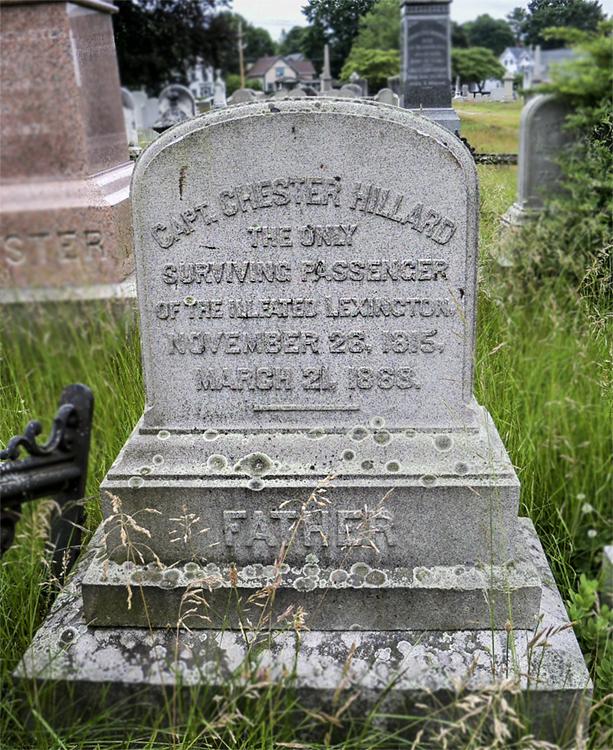
Chester lived to the age of 52, and his gravestone is shown here. It reads:
“THE ONLY SURVIVING PASSENGER OF THE ILLFATED LEXINGTON”